
Beeswax: How Bees Make It and How to Use It
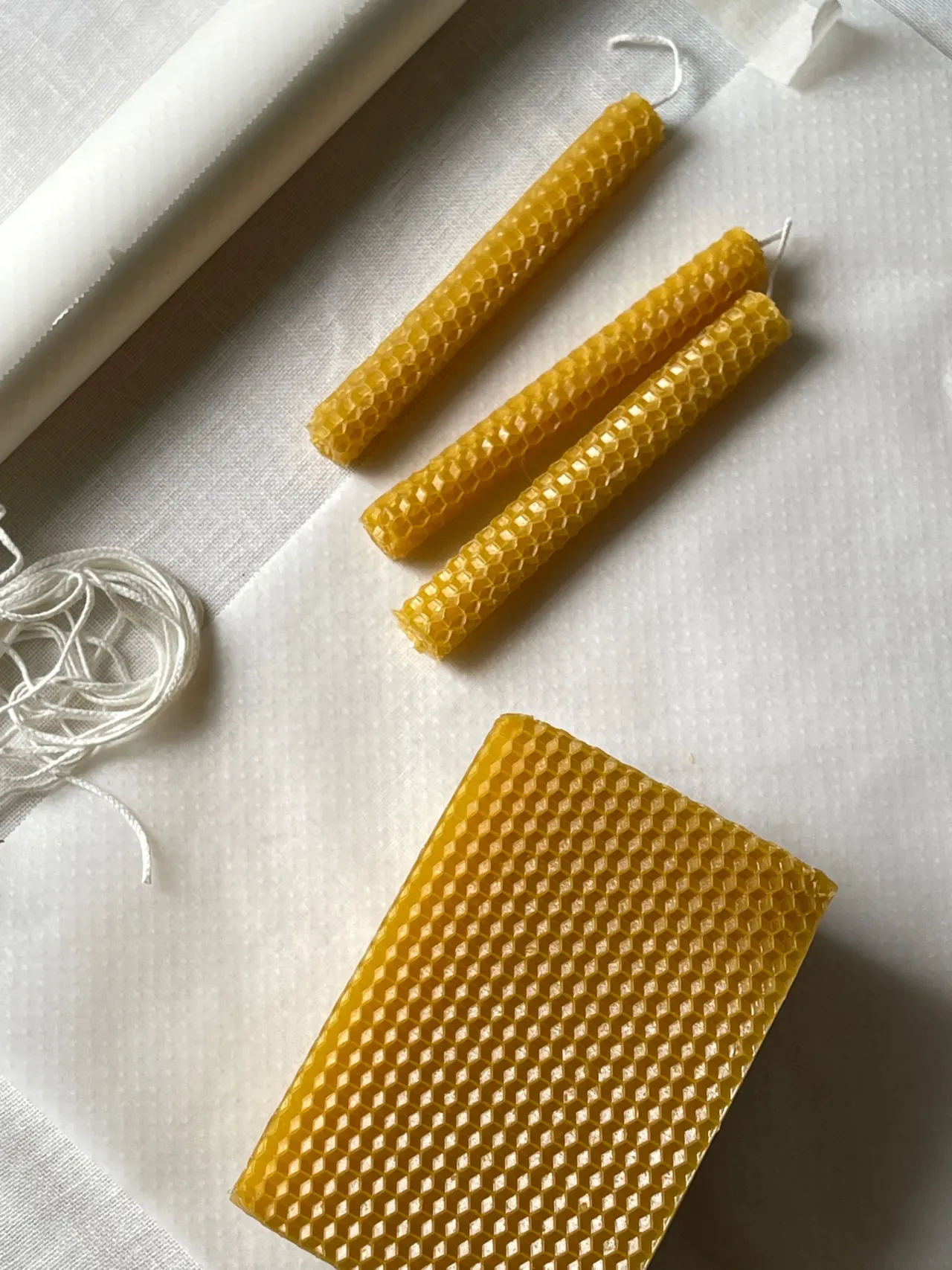
Beeswax is secreted by young worker bees through four pairs of glands on the underside of their abdomen; they then shape it to build the hexagonal cells of the comb, where they store honey and raise the brood. Producing it costs the colony a great deal of honey, which makes it a precious material. At home, it is used to make wax wraps, candles, balms and wood care products, and in the kitchen it coats cannelé moulds.
What is beeswax?
Beeswax is a natural fatty substance made by the honey bee to build its comb. It consists mainly of esters, formed from fatty acids and long-chain alcohols, together with hydrocarbons and free fatty acids. It is solid at room temperature, pliable when warmed in the hands, and melts at around 62 to 65 °C.
When first secreted, wax is white, almost translucent. It then takes on a yellow to brown colour from contact with honey, pollen and propolis, the resin bees collect from tree buds. Comb in which several generations of larvae have grown darkens further, because of the cocoons left in the cells. That is why you will find yellow beeswax on sale, the most common kind, and white beeswax, bleached by the sun or by filtration.
Beeswax is also an authorised food additive in the European Union, under the code E901, where it is mainly used as a glazing agent, for example to give shine to some fruit or confectionery.
How do bees make wax?
Only worker bees produce wax, and only at a certain age. Their wax glands develop during the first weeks of their life and are generally most active from around the twelfth to the eighteenth day. These four pairs of glands are on the underside of the abdomen.
To produce wax, the young workers hang from one another in clusters, at a temperature of around 35 °C, and eat honey. Their bodies turn part of the sugars into wax, which comes out of the glands as tiny transparent scales. The bee picks them up with its legs, chews them with its mandibles to make them pliable, then adds them to the comb being built.
The cells are hexagonal, a shape that stores the most honey with the least wax. That economy matters, because wax is costly for the colony: estimates vary from one source to another, but it is thought to take something like 6 to 10 kg of honey, or more, to produce one kilo of wax. This is one reason beekeepers give bees back comb that has already been built. To follow the rest of the story, from nectar to capped honey, read our article on how bees make honey.
How do beekeepers collect wax?
Wax is not harvested for its own sake: it is mainly a by-product of the honey harvest. When the cells are full of ripe honey, the bees seal them with a thin lid of wax, the capping. To extract the honey, the beekeeper removes these cappings with an uncapping knife or fork. This cappings wax, young and pale, is the most sought after.
Old frames that have become too dark are melted down in turn, often in a solar wax melter, a glass-topped box in which the sun melts the wax so that it runs into a tray. The wax is then filtered and poured into blocks. Much of it is used to make wax foundation, the sheets embossed with hexagons that beekeepers place in the frames to guide the building of new comb. Wax thus goes round in a loop from one season to the next.
This recycling has a downside: over the years, wax can build up residues of treatments used in the hives or in the environment. For cosmetic or food use, it is therefore better to choose cappings wax of known origin, bought from a beekeeper or a supplier who states where it comes from.
What is beeswax used for at home?
Wax is worked when melted, then sets as it cools: that is what makes it so handy. Here are its most common household uses.
| Use | How it works | Precaution |
|---|---|---|
| Wax wraps | Cotton fabric soaked in melted wax | No raw meat or fish, wash in cold water |
| Candles | Wax poured around a cotton wick | A thicker wick than for paraffin |
| Wood care | Wax mixed with an oil or a solvent | Food-grade oil for chopping boards |
| Homemade cosmetics | Wax, butter and vegetable oil | Test on a small patch of skin |
| Cooking | Cannelé moulds, comb honey | Food-grade wax only |
- Wax wraps replace cling film for covering a bowl or wrapping a piece of cheese. Lay a square of fine cotton, about 25 cm across, on a tray lined with baking paper, scatter about fifteen grams of grated wax over it and put it in the oven at 85 °C for a few minutes, until the wax melts. Spread it with a brush, then hang the fabric up to cool. Washed in cold water, it lasts for several months.
- Beeswax candles burn slowly and give off a light scent of honey. Wax, which is denser than paraffin, needs a thicker cotton wick. A faint white film may appear on the surface over time: this is a natural phenomenon, which disappears when rubbed with a cloth.
- Wood care is an age-old use: traditional furniture polish combines wax and turpentine. For a chopping board or a wooden utensil, use a mixture of wax and food-grade vegetable oil instead, about one part wax to four parts oil, renewed from time to time.
- Homemade cosmetics use wax to give balms their body. A simple lip balm combines, by weight, one part wax, one part shea butter and two parts sweet almond oil. Honey also goes into homemade skincare, such as our honey face masks for winter.
Can you eat beeswax?
Yes, in small quantities. Wax is not digested by the body: it passes through the digestive tract without being absorbed. That is what happens when you eat comb honey, where the wax is chewed along with the honey it holds.
In baking, beeswax is inseparable from the cannelé of Bordeaux. The copper moulds are coated with a mixture of food-grade beeswax and butter, often in equal parts depending on the recipe, then well drained. This thin layer gives the cannelé its glossy, caramelised crust and helps it come out of the mould.
For any food use, choose wax sold as food grade, filtered and of known origin. Wax intended for candles or furniture care does not offer the same guarantees.
How can you work with beeswax safely?
Wax is flammable and melted wax burns the skin. A few simple habits prevent accidents.
- Melt it in a bain-marie, never over a direct flame, and never leave it unattended.
- Ideally, keep utensils just for this purpose: wax is hard to remove from pans.
- Never pour melted wax down the sink, where it sets and blocks the pipes; wipe away leftovers while still warm with kitchen paper.
- Grate the wax or break it into small pieces: it will melt faster and more evenly.
- Skin reactions are rare but possible, particularly in people sensitive to propolis: test a balm on a small area before using it.
Wax, pollen, propolis and honey together make up the work of a colony. Miellerie de Provence does not sell wax: each year we select six honeys harvested in Provence by partner beekeepers, cold-extracted and never pasteurised. For wax, you would do better to contact a beekeeper near you or a beekeeping equipment supplier. And to taste the variety of blossoms that wax was made to store, the complete collection of six honeys (€75, free delivery) brings them all together.
Frequently asked questions
How do bees make wax?
Young worker bees, about two to three weeks old, secrete wax through four pairs of glands on the underside of their abdomen, after eating honey. The wax comes out as small scales, which the bee chews before adding them to the comb.
How much honey does it take to make a kilo of wax?
Estimates vary from one source to another, most often something like 6 to 10 kg of honey, sometimes more. That is why beekeepers reuse comb and recycle wax into foundation sheets.
Is beeswax edible?
Yes, in small quantities: it is not digested and passes through the body without being absorbed. It is eaten with comb honey, and it is authorised as a food additive under the code E901.
What is the difference between yellow and white beeswax?
Yellow beeswax is natural wax, coloured by honey, pollen and propolis. White beeswax is the same wax, bleached by the sun or by filtration; it has less smell and is often used in cosmetics.
How do you clean a utensil covered in wax?
Wipe it while still hot with kitchen paper, then wash it in very hot water. For stubborn residues, a little warm vegetable oil dissolves wax better than water.