
How Do Bees Make Honey?
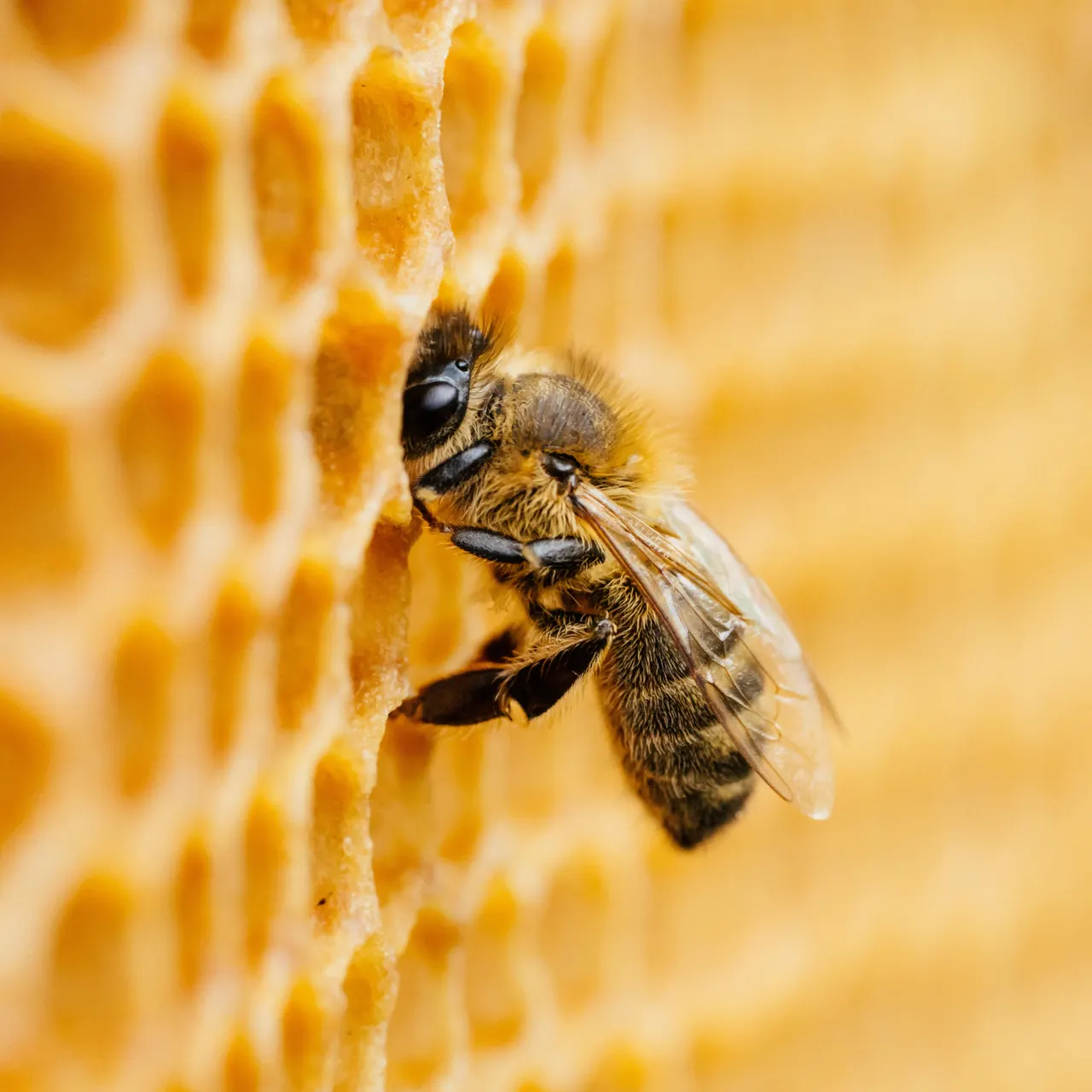
We all have a jar in the kitchen, but the story of how it is made is far more fascinating than you might imagine. Honey is not simply “collected” from flowers; it is meticulously made by bees in a veritable biological factory. Contrary to popular belief, it does not all begin with carrying pollen, but with a far more precise mission at the very heart of the flower.
This mission is entrusted to specialised workers: the foragers. Their job is to fly from flower to flower in search of the key ingredient, a sugary liquid called nectar, which serves as fuel for the whole colony. To draw it up, the bee unfurls its long tongue (the proboscis), which works like a built-in straw and lets it sip this precious resource. This is the very first step in explaining how bees collect nectar.
So what is the pollen you often see in little pellets on their legs for? It is the second part of their harvest, intended for another use. While nectar, made of water and sugars, is used to make honey, pollen is an essential source of protein for feeding the young larvae. The role of the forager bee is therefore twofold: it gathers both energy for the adults and building materials for the new generation, without ever mixing the two up.

Step 2: The Secret of the “Double Stomach” for Efficient Transport
Once the bee has drawn up the precious nectar, a question arises: how does it carry it back to the hive without drinking it? For this it has a remarkable organ, a kind of “second stomach” called the crop, or honey stomach. Picture it as a small internal backpack, a portable tank able to hold nearly 70 milligrams of nectar, almost the weight of the bee itself.
What is fascinating is that this crop is completely separate from its digestive stomach. The nectar stored there is not meant to feed the bee there and then; it is a precious cargo reserved for the whole colony. This biological separation is essential: it ensures that the nectar stays pure, without being broken down by the digestive juices the bee uses for its own energy.
But the crop is much more than a simple reservoir. On the flight home, the magic is already at work. Special enzymes, natural substances produced by the bee, mix with the stored nectar. This is the starting signal for the chemical transformation that will slowly turn this flower juice into honey. The process is therefore already under way before the bee has even got home.
Step 3: Trophallaxis, or the Teamwork That Sets the Magic in Motion
Back at the hive, heavily laden with nectar, the forager does not store its harvest directly. Instead, it finds a house bee, a “receiver”, and passes its cargo on in a fascinating mouth-to-mouth exchange. This handover, which can be repeated up to 20 times between different workers, has a scientific name: trophallaxis. It is much more than a simple transfer; it is the first stage of the collective work that will give rise to honey.
It is during this process that the real alchemy happens. Each time it passes from one bee to the next, the nectar mixes with new digestive enzymes. Think of these enzymes as tiny biological scissors. Their task is to cut the long, complex sugars in nectar (sucrose, like our table sugar) into much shorter, simpler sugars: glucose and fructose. This transformation of nectar into honey is a little like a pre-digestion on the scale of the whole colony.
This production line is absolutely essential. By breaking down the sugars, the bees make the future honey easier for them to digest and, above all, far more stable. This unique composition prevents bacteria from developing and ensures that their food stores will not spoil during the long winter months. The nectar is now chemically transformed, but one challenge remains: it still contains nearly 80% water. It is time for the bees to move on to the drying stage.
Blossom Honey vs Forest Honey: the Special Case of Honeydew
We always picture bees foraging on pretty, colourful flowers to make their honey. That is true in most cases, but it is not their only resource. What happens when flowers become scarce, for example in the forest or at the end of summer? The bees, remarkably resourceful, turn to another sugary source: honeydew.
So what exactly is honeydew? It does not come from a flower, but from a tree, by way of other insects. Aphids or scale insects, for example, feed on tree sap. They absorb what they need and excrete the surplus as sugary droplets on the leaves and branches. For bees, this is a windfall: they collect this liquid, rich in sugars and minerals, just as they would nectar. The difference between nectar and honeydew is therefore simple: one comes from flowers, the other from the sap of trees.
This is the origin of so-called “forest” honeys, such as the well-known fir or oak honey. Their different source explains their distinctive character: they are generally darker, less sweet on the palate and have a more pronounced taste, with woody notes. This natural honey is particularly rich in trace elements. But whether it comes from a flower or a tree, the liquid collected is still too watery. For the bees, the next mission is the same: to dry it.
Step 4: The Hum of the “Fanning Bees” to Thicken the Honey
Once in the hive, the nectar brought back by the foragers is still far too runny. At nearly 80% water, this very dilute syrup would quickly spoil, rather like fruit juice left out in the open. Yet the purpose of honey is to serve as a food store for the whole winter. So the bees have to find a way to preserve it, and for that, the water has to go.
To solve this problem, they have a surprising technique: they turn themselves into living fans. After depositing the nectar in the small wax cells of the comb, the honeycomb cells, a group of workers gets to work. They take up position at the hive entrance and near the combs, then beat their wings at dizzying speed. This constant hum is no accident: it creates a flow of warm, dry air that circulates through the whole colony.
This meticulous process, the evaporation of water in the hive, is a real labour of patience. The air current passes over thousands of open cells, each holding a small drop of nectar. Slowly but surely, the water evaporates and the future honey thickens. It is impossible to say precisely how long it takes to make honey, as it depends on the humidity of the air and the strength of the colony, but this stage can take several days.
The result? The nectar, which was a clear liquid, becomes a thick, viscous syrup whose water content has dropped below 20%. At this stage, the honey finally has the ideal consistency to keep for months, even years, without going mouldy. The larder is almost ready. All that remains is to put the lids on.
Step 5: Capping, the Wax Seal for a Perfect Larder
Now that the honey has the perfect consistency, the bees cannot leave it exposed to the air in the cells. Just as we put a lid on a jar of jam to protect it, they have to seal their precious larder. To do so, they produce brand-new, bright white wax, with which they close each cell filled with honey. This final stage is called capping.
This little wax lid, called a cap, is much more than simple protection. It acts as a perfect airtight seal that isolates the honey from air and moisture. This natural barrier stops the honey from taking up water again and fermenting, ensuring the storage of honey in the cells in ideal conditions. It is this wax seal that turns the honeycomb into a true food fortress.
The result is a masterpiece of preservation. Thanks to this capping of the wax cells, natural honey can keep for months, even years, without ever deteriorating. The colony’s larder is at last ready for winter.

The Real Purpose of Honey: Why Do Bees Work So Hard?
Why so much effort? Contrary to popular belief, bees do not make honey for us. It is their larder, their collective life insurance. When the cold sets in and the flowers disappear, the supply of nectar dries up. Honey then becomes their only source of food to get through the long winter months. That is the fundamental reason why bees make honey: to survive.
The scale of the task is immense. A single colony can number up to 50,000 individuals in the warm season, and for all of them to get through the winter, colossal reserves are needed. It is estimated that a hive needs to consume between 15 and 30 kilograms of honey to last until the following spring. Every drop is therefore vital and justifies this incredible teamwork. These reserves are the bees’ food for the winter, a treasure built up through a titanic collective effort.
This golden fuel is therefore much more than a simple treat. For bees, the benefits of honey are many: it is an ultra-concentrated source of energy, easy to store and perfectly preserved thanks to its low water content and to capping. It is the survival food par excellence. Fortunately for us, bees plan ahead and often produce a surplus. It is this safety margin that the beekeeper can carefully harvest.
From Hive to Kitchen: How Do People Harvest Honey?
The journey from the hive’s larder to our jar of honey is a delicate stage that rests on a pact of respect between people and bees. A responsible beekeeper never takes all the reserves. They make sure to leave enough honey for the colony to get through the winter without difficulty. This is the fundamental principle of sustainable beekeeping: people take only the surplus. The harvest therefore only takes place at the end of the main flowerings, when the frames of the hive are brimming with this golden treasure.
To collect this treasure, the beekeeper takes the full frames out of the hive. They then remove the thin layer of wax (the cap) that the bees built to seal each cell. The next step is extraction. The frames are placed in an extractor, a machine that uses centrifugal force to spin the honey out of the cells, a little like a salad spinner. This gentle method preserves the wax combs, which the bees can reuse, saving them a considerable amount of energy.
Freshly extracted honey contains small particles of wax and pollen. To obtain a pure natural honey, it is simply passed through a kind of sieve to remove these impurities. That is all. A raw honey or artisanal honey stops there. By contrast, some industrial honeys are heated to high temperatures (pasteurised) and ultra-filtered, which can alter their subtle aromas and their properties.
So the path from flower to honey jar is less a matter of manufacturing than of collaboration. The beekeeper acts as a guardian who watches over the health of the colonies and gratefully harvests the fruit of their exceptional work. This process shows us a possible harmony between nature and people, a lesson that goes far beyond simple food production.

More Than Just Sugar: What Honey-Making Teaches Us
Behind every golden drop lies an extraordinary adventure, far more complex than simply flitting from flower to flower. The next time you open a jar, you will no longer see a simple sweet food, but the fruit of colossal teamwork: thousands of kilometres flown, millions of flowers visited and a patient transformation at the heart of the hive.
This fascinating honey-making process is a true lesson in natural engineering, in which every bee plays an indispensable role. The qualities of honey are no accident, but the logical consequence of this alchemy: a concentrate of floral energy and meticulous work. Every spoonful then becomes a tribute to the spectacular, silent intelligence of nature.
From nectar to jar: taste the difference
All this work by the bees can be preserved… or destroyed by industrial pasteurisation. Our honeys are cold-extracted and jarred raw, with their enzymes intact: discover our honeys harvested in Provence and read how to recognise a quality honey.