
Bee pollen: harvest, benefits, fresh or dried
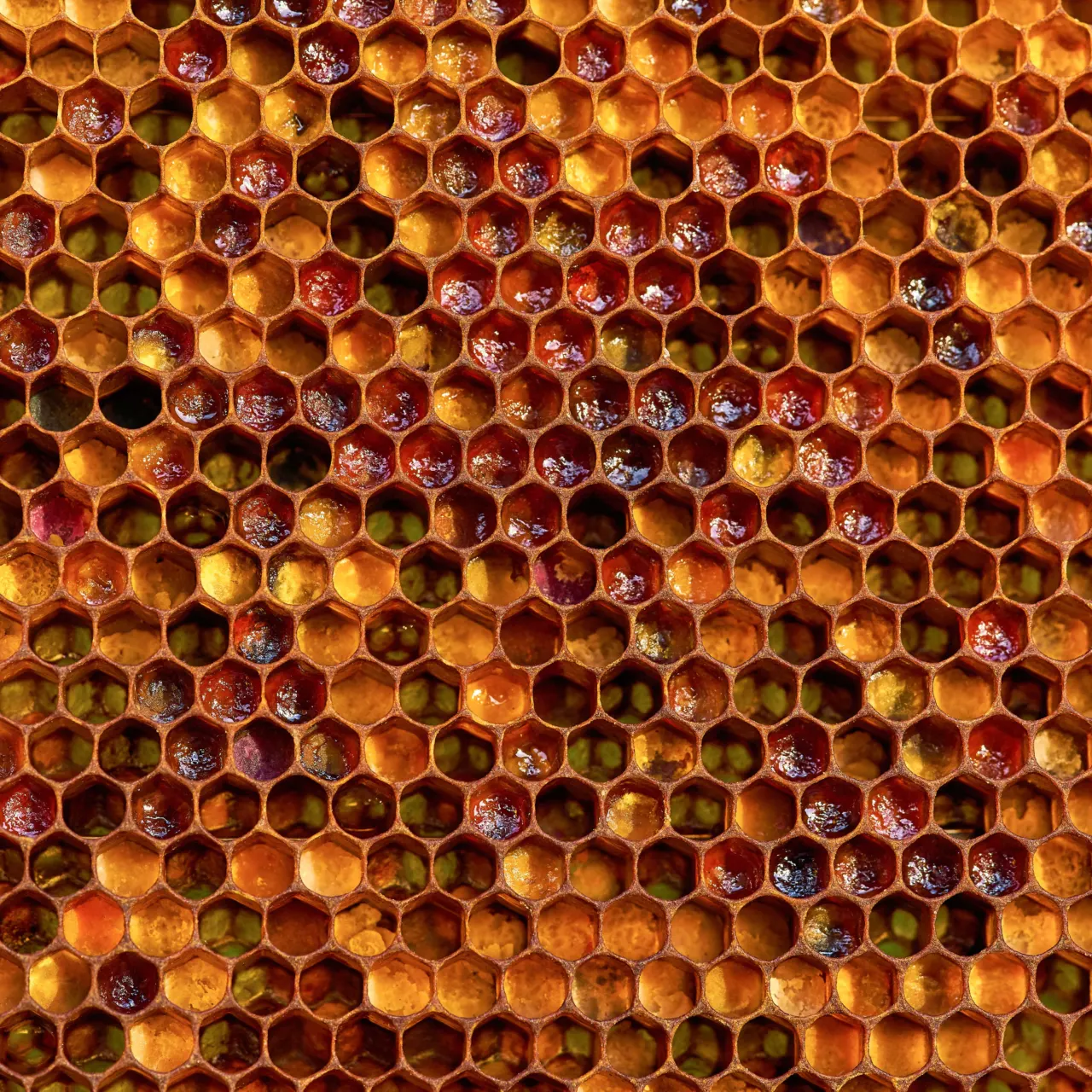
Bee pollen is the fine, fertilising dust of flowers, which honeybees pack into small coloured pellets to feed their larvae: it is the hive’s main source of protein. Beekeepers collect it at the hive entrance and sell it fresh (frozen) or dried, to sprinkle over yoghurt or stir into a spoonful of honey. Valued for its composition, it should be avoided by anyone allergic to pollen or to bee products.
What is bee pollen?
Pollen is the male element of a flower: a very fine powder of microscopic grains that allows plants to be fertilised. For a honeybee, it is first and foremost food. Nectar provides the sugars that will become honey; pollen supplies the protein, fats, minerals and vitamins the colony needs to raise its young.
What we call “bee pollen”, or pollen pellets, is therefore not pollen exactly as it leaves the flower. It is pollen that the bee has bound together with a little nectar and saliva, then carried back to the hive as tiny balls a few millimetres across. Each pellet usually comes from a single plant species. Hence the palette in a jar of bee pollen: bright yellow, orange, ochre, green, grey, sometimes almost black.
How do bees collect pollen?
As she visits a flower, the forager becomes dusted with pollen, which clings to the hairs on her body. In flight, she brushes it off with her legs, moistens it with nectar and presses it into her pollen baskets, two small hair-fringed hollows on her hind legs. These are the pellets you can see on bees returning to the hive.
Inside, worker bees store the pollen in cells close to the brood. Packed down and mixed with honey, it ferments slightly and becomes “bee bread”. Young nurse bees eat it to produce food for the larvae. A colony needs several dozen kilos of pollen a year: without it, there are no new bees.
Pollen sources follow one another through the seasons, from the first trees in flower at the end of winter to the blossoms of summer. In Provence, the rockroses of the garrigue are a good example: their large spring flowers yield mostly pollen, and little or no nectar.
How do beekeepers harvest pollen?
Beekeepers use a pollen trap: a grid pierced with holes of a set size, fitted at the hive entrance. To get back in, foragers have to squeeze through the holes, and some of the pellets are knocked off their legs. They fall through a mesh into a drawer that the beekeeper empties regularly.
A well-adjusted trap only catches part of the pollen brought home. It is fitted during periods of heavy flowering, then removed so that the colony keeps enough to feed its brood. Harvesting pollen therefore calls for strong colonies and close attention: it is a demanding product, gathered in small quantities.
For good fresh bee pollen, the drawer is emptied every day or nearly so. The pollen is then sorted to remove debris and frozen straight away. Dried pollen is dried at a low temperature before being sieved and jarred.
Fresh or dried bee pollen: which should you choose?
Both come from the same harvest. What differs is how they are stabilised. Freshly collected pollen holds a lot of water, often around 20 to 30% according to commonly cited figures, and spoils quickly at room temperature. It must therefore be frozen or dried.
| Criterion | Fresh pollen | Dried pollen |
|---|---|---|
| Stabilisation | Frozen just after harvest | Gently dried at a low temperature |
| Texture | Soft, slightly sticky pellets | Hard, crunchy pellets |
| Flavour | Fruitier and more floral, sometimes tangy | Drier, dustier, sometimes more bitter |
| Storage | In the freezer; a few days in the fridge once thawed | Several months in a sealed jar, kept dry and away from light |
| Price | Generally higher | More affordable |
| Who is it for? | Enthusiasts looking for a product as close to the hive as possible | Everyday use, travel, a first taste |
Connoisseurs often prefer fresh pollen: freezing keeps its texture and flavour, whereas drying, however gentle, alters some of its more delicate compounds. Dried pollen remains a good, more practical option, provided it has been dried at a low temperature.
What does bee pollen contain?
The composition of pollen varies widely with the flowers visited, the region and the season. The figures below are orders of magnitude per 100 g of dried pollen, taken from the standardisation work of the International Honey Commission (Campos et al., Journal of Apicultural Research, 2008). They give ranges, not the exact value for any particular jar.
| Component | Per 100 g of dried pollen | Worth knowing |
|---|---|---|
| Protein | 10 to 40 g | The share behind its reputation, with a varied range of amino acids |
| Carbohydrates | 13 to 55 g | Mostly sugars, including those from the nectar that binds the pellets |
| Fats | 1 to 13 g | Including fatty acids and sterols |
| Fibre | 0.3 to 20 g | Mainly in the outer wall of the grains |
| Minerals | 2 to 6 g | Potassium, phosphorus, calcium and magnesium, among others |
Bee pollen also provides vitamins, notably B vitamins, carotenoids, which give it its colours, and phenolic compounds such as flavonoids. These vary from one plant to another: a multicoloured pollen, drawn from many species, is generally more varied than a single-coloured one.
Keep proportions in mind: a teaspoon weighs only a few grams. Bee pollen complements a diet; it does not replace a source of protein or a balanced meal.
What are the benefits attributed to bee pollen?
Bee pollen has a long-standing reputation as an invigorating food. It is traditionally taken for a few weeks at the turn of the seasons, in autumn or at the end of winter, by people looking to enrich their diet. Athletes and people who eat few animal products appreciate it for its protein content.
The ways to enjoy it are simple and delicious:
- As a seasonal course: one to two teaspoons a day for adults, according to common practice, starting with just a few pellets.
- At breakfast: sprinkled over yoghurt, fromage frais, muesli or a homemade honey granola.
- With honey: stirred into a spoonful of raw honey, which rounds off its sometimes bitter taste.
- In a smoothie: blended with fruit, it dissolves and colours the drink.
These uses belong to tradition and nutrition, not medicine. In the European Union, a food may only claim an effect on health if that claim has been authorised following a scientific assessment by EFSA, the European Food Safety Authority. Be wary of spectacular promises: bee pollen is an interesting food, not a remedy.
Bee pollen: what precautions should you take?
Bee pollen is not a harmless food for everyone. A few sensible rules apply:
- Allergies: anyone allergic to pollen (hay fever, asthma) or to bee products should avoid it unless a doctor advises otherwise. Allergic reactions, sometimes severe, have been reported.
- Pregnancy and breastfeeding: data are lacking; ask your doctor or midwife first.
- Children: ask your paediatrician. If you mix bee pollen with honey, remember that honey must never be given to a child under one year old, because of the risk of infant botulism.
- Current treatment: if you take any medication, particularly an anticoagulant, talk to your doctor or pharmacist.
- First time: start with a few pellets and increase gradually to check your tolerance.
If you notice itching, swollen lips or difficulty breathing, stop at once and see a doctor.
How to choose and store bee pollen
A good bee pollen is recognised first by a clear label:
- Origin: the country and, ideally, the region of harvest. Pollen of vague origin, or blended from several countries, tells you little about its freshness.
- Date: a harvest date, or at least a legible best-before date.
- Method: frozen fresh, or dried at a low temperature.
- Appearance: whole pellets in clear colours, without much dust, debris or any musty smell.
- Type: multifloral, with mixed colours, or monofloral (rockrose, chestnut, willow and so on), with a more pronounced taste.
Fresh bee pollen belongs in the freezer. Take out a week’s worth, keep it in a closed jar in the fridge and never refreeze thawed pollen. Dried pollen keeps in an airtight jar, somewhere cool, dry and dark, until the date shown. If it softens or its smell changes, it has absorbed moisture: better not to eat it.
Bee pollen and honey: what is the difference?
Honey and pollen both come from flowers, but not from the same part, and they play different roles. Honey is made from nectar, or from the honeydew of trees, which bees transform and concentrate: it is their energy store, made up mainly of sugars, around 80 g per 100 g. Pollen is their protein store. To discover the bees’ other great plant harvest, tree resin, read our guide to propolis.
Pollen does, however, find its way into the honey jar. A raw honey, cold-extracted and simply strained, contains fine particles of pollen, in far too small a quantity to compare with pollen pellets. These particles are what allow a laboratory to check a honey’s floral origin. Very fine filtration removes them, and the regulations then require the label “filtered honey”. Our page on raw, unpasteurised honey explains what is gained by keeping honey in its natural state.
The honeys we select from partner beekeepers in Provence keep their natural pollen. Chestnut honey, woody and slightly tannic, comes from a tree that produces abundant pollen. Garrigue honey, round and smooth with notes of thyme and rosemary, reflects the floral diversity of the hills. And lavender honey, gentle and creamy, is a lovely companion to a spoonful of bee pollen on yoghurt.
Frequently asked questions
What are the benefits of bee pollen?
Bee pollen is valued above all for its composition: rich in protein, it also provides fibre, minerals, B vitamins and phenolic compounds. It is traditionally taken as a seasonal course to enrich the diet, without any therapeutic effect being expected of it.
How much bee pollen should you take a day?
Common practice is one to two teaspoons a day for adults, starting with a few pellets to test your tolerance. If you have allergies, are pregnant or are on medication, ask your doctor first.
How do you eat fresh bee pollen?
Take the amount you need out of the freezer and eat it as it is, sprinkled over yoghurt or fruit, or stirred into a spoonful of honey. Avoid heating it: cooking spoils its flavour and texture.
Can you eat bee pollen if you have a pollen allergy?
Caution is essential: people allergic to pollen or to bee products can react to bee pollen, sometimes strongly. Do not take it without the advice of your doctor or allergist.
Does honey contain pollen?
Yes. A raw, simply strained honey naturally contains fine particles of pollen, in very small amounts. These grains make it possible to identify the honey’s floral origin; fine filtration removes them.