
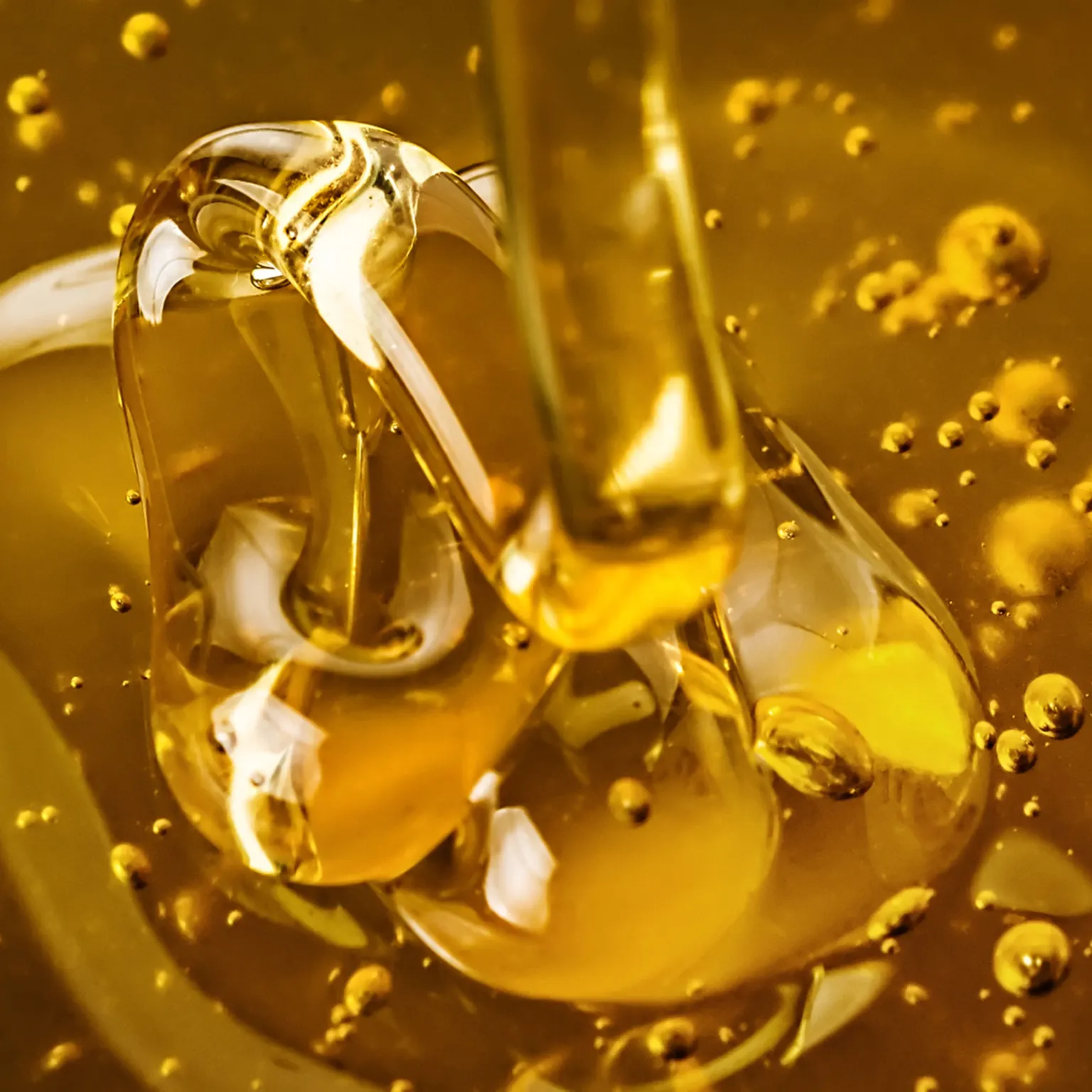
Raw, unprocessed or unpasteurised honey is honey that has never been heated above the temperature of the hive (around 35 to 40 °C) and has only been coarsely filtered. It retains its enzymes, its volatile aromas and its pollen, and it crystallises naturally. It is the only honey we sell.
Raw, unprocessed, unpasteurised: three closely related terms
The three expressions are often used interchangeably. ‘Raw’ and ‘unpasteurised’ mean the honey has not been heated; ‘unprocessed’ adds the idea of a minimally filtered honey; ‘unpasteurised’ names the step the honey has not been through. In France, none of these terms is a regulated label: what counts is the seller’s commitment. Ours is simple: the partner beekeepers we work with cold-extract the honey, let it settle, filter it coarsely and put it in jars. Nothing else.
Why is honey pasteurised?
Pasteurised honey is heated to between 70 and 80 °C for a few minutes, then cooled rapidly. The industry does this for three reasons: to keep honey liquid for longer on the shelf, to destroy yeasts that could make it ferment if it is too moist, and to allow fine filtration so that it is perfectly clear. None of these reasons has anything to do with quality for the person eating it. A honey harvested when ripe, with less than 18% moisture, does not need to be heated to keep for years.
What heat takes away from honey
- Enzymes: glucose oxidase (the source of honey’s antibacterial properties), invertase and diastase are fragile. Above 40 °C their activity drops; above 60 °C it largely disappears. Laboratories in fact use the diastase number to detect overheated honey.
- Aromas: the volatile compounds that make the difference between a thyme honey and a lavender honey evaporate with heat. Pasteurised honey often tastes flatter, simply sweet.
- Pollen: fine filtration removes the pollen grains. Yet pollen is also the botanical and geographical signature of a honey; without it, its origin cannot be proven in a laboratory.
- A heating marker appears: HMF (hydroxymethylfurfural) increases with temperature and time. A fresh, unheated honey contains less than 10 mg/kg; the European standard allows up to 40 mg/kg.
Crystallisation: the sign of a living honey
All honeys crystallise, more or less quickly depending on their glucose/fructose ratio. A lavender or garrigue honey (garrigue being the wild Mediterranean scrubland) crystallises within a few weeks into a fine, creamy texture; a chestnut or forest honey, rich in fructose, stays liquid for months. A honey that stays clear forever has almost always been heated or blended. To liquefy a crystallised jar, a bain-marie below 40 °C is enough, and the honey loses nothing.
How to recognise genuine unpasteurised honey
- It crystallises over time, evenly, and its texture varies from one honey to another.
- It has a distinct aroma when you open the jar and a flavour that develops on the palate, not just sweetness.
- It is slightly cloudy or contains fine particles: these are pollen and wax.
- The seller can tell you exactly where it comes from: beekeeper, terroir, harvest season.
We go into these points in more detail in our article how to recognise a quality honey.
Our six raw honeys
All our honeys are harvested in Provence by partner beekeepers we know, cold-extracted and jarred without heating or blending: lavender, thyme, chestnut, garrigue, mountain and forest, in 300 g jars. To discover them, the Discovery Box brings together the three most emblematic.
Unprocessed honey: is it the same as raw honey?
Not quite, even though the two words are often used interchangeably. ‘Raw’ refers to temperature: raw honey has not been heated above hive temperature after harvest. ‘Unprocessed’ (brut in French) refers rather to how much the honey has been handled: it has been extracted, left to settle and, at most, coarsely strained. It may therefore contain fine particles of wax and pollen, which sometimes make it look slightly cloudy.
Neither term has a legal definition: what they are worth depends on the seller’s commitment. A honey can be raw without being unprocessed, for instance if it has been filtered more finely without being heated. It can also be both: that is the case with our honeys, which are cold-extracted, simply left to settle and coarsely strained.
Frequently asked questions
Is raw honey dangerous for children?
Like all honey, raw or pasteurised, it is not recommended for babies under 12 months because of the risk of infant botulism; pasteurisation does not destroy the spores concerned. After one year, there is no contraindication.
Does unpasteurised honey keep for less time?
No. A honey harvested when ripe keeps for several years at room temperature, away from light and moisture. The best-before date on the jar is a regulatory indication, not an expiry date. See does honey go off?
Are raw honey and organic honey the same thing?
No. ‘Organic’ concerns the way the bees are kept and the environment of the hives; ‘raw’ concerns the absence of heating after harvest. An organic honey can be pasteurised, and a raw honey may not be certified organic. Our honeys are not certified organic; they are raw.
Why has my honey hardened?
Because it is alive: crystallisation is natural and changes neither the flavour nor the qualities of the honey. A gentle bain-marie will make it liquid again if you prefer it that way.