
Which Honey for a Cough and Sore Throat? The Best Honeys

The best honey for a cough is thyme honey: rich in thymol, a natural antiseptic, it calms irritation and cleanses the throat. For a chesty cough, eucalyptus honey is the most suitable; for a sensitive throat, lavender honey; and to support you through winter, forest and garrigue honeys complete the range. Here is the complete guide to choosing the right jar, and using it well.
That dry cough that wakes you at night or irritates your throat all day long… What if the answer was already in your cupboard? Honey is a universally known grandmother’s remedy for coughs, and this popular wisdom is now backed by science: the World Health Organization (WHO) recognises honey as a potential treatment for coughs, particularly in children. Its action is twofold: its thick texture forms a protective layer that soothes the throat, while its natural components contribute to its health benefits.
Which honey should you choose for your symptoms? The summary table
| Symptom | Recommended honey | Why |
|---|---|---|
| Dry, tickly cough | Thyme honey | Antiseptic thymol, a recognised calming action |
| Sore, irritated throat | Thyme or lavender | Soothing effect, a much-loved gentleness |
| Chesty cough, congested airways | Eucalyptus or forest honey | Balsamic properties, helps to clear the chest |
| Cold, flu-like symptoms | Garrigue honey or mountain honey | Traditional winter tonics |
| Night-time cough | Thyme honey (1 spoonful at bedtime) | Long-lasting relief from irritation |
Why does honey really calm a cough?
Honey’s effectiveness at calming a cough rests on a simple physical mechanism. When you swallow it, its thick, syrupy texture coats the irritated lining of your throat, creating a natural protective film. This soothing layer immediately reduces the tickling sensation that triggers the urge to cough, bringing almost instant relief.
Beyond this mechanical effect, honey has valuable intrinsic qualities. It naturally has antibacterial properties, which means it helps to curb the growth of the microbes that can cause inflammation. This cleansed environment allows your throat to recover more calmly.
This twofold action – soothing and cleansing – explains the many benefits of honey for the airways. It does not just mask the symptom; it creates conditions that favour healing. However, the strength of these properties varies enormously from one honey to another, depending on the flowers it comes from.
Dry or chesty cough: why is the choice of honey crucial?
Just as different medicinal plants have distinct virtues, the honeys made from them inherit specific properties. When bees forage on thyme, lavender or eucalyptus, they carry the unique benefits of each plant back to the hive. That is why a fir honey will not have the same action as an acacia honey.
Before choosing a jar, identify what kind of cough you have. Is it a dry cough, irritating and unproductive? Or a chesty cough, trying to bring up phlegm to clear your airways? The first needs calming, while the second needs help to loosen and clear the mucus.
For a dry cough, choose a honey with recognised antiseptic and calming properties, such as thyme honey. For a chesty cough, on the other hand, a honey such as eucalyptus will be more suitable. Matching the right honey to the right symptom turns this simple remedy into a targeted solution.
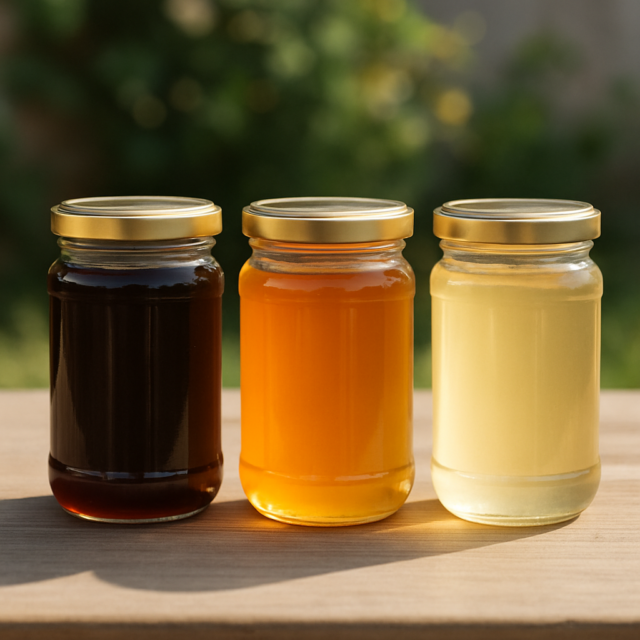
Thyme honey: your best ally against a dry, irritating cough
If a dry, persistent cough is irritating your throat, thyme honey is often considered the most effective answer. Powerful and aromatic, it inherits the antiseptic and anti-inflammatory properties of thyme directly, a plant used for centuries for its benefits on the airways.
Its compounds help to cleanse the irritated area, while its thick texture coats the throat with a protective film, instantly calming the tickle. It is the best honey for a dry cough, because it acts both on the irritation and on its microbial cause.
Particularly valued for calming a night-time coughing fit, thyme honey offers a welcome respite for more restful sleep. A simple spoonful before going to bed, on its own or stirred into a warm (never boiling) drink, is often enough to ease the urge to cough. Its solid reputation makes it the first choice for fighting the discomfort of an inflamed throat.
What is the best honey for the throat?
For a simple sore throat (irritation, a tickle, a hoarse voice) two honeys stand out:
- Thyme honey, the most complete: its thymol cleanses while its texture soothes. It is the choice for really painful throats.
- Lavender honey, the gentlest: traditionally valued for its soothing virtues, it is perfect for sensitive throats and for children, who love its floral taste.
The effective habit: let a teaspoon of honey melt slowly in your mouth, several times a day, to prolong contact with the lining of the throat. In a herbal tea (chamomile, thyme or verbena), add the honey once the drink has cooled slightly, to preserve its properties.
Congested chest, a cold: which honey should you choose?
When a cough becomes “chesty” or productive, it is a sign that your airways are congested. For this type of cough, eucalyptus honey takes over: famous for its virtues on the respiratory system and its balsamic sensation, it helps to loosen mucus and make the cough more productive. If you prefer a French terroir honey, forest honey, rich and woody, is the traditional alternative for congested airways.
If you have a cold or flu-like symptoms, the aim is as much to support the body as to calm the cough: the characterful polyfloral honeys, garrigue (thyme, rosemary, savory) and mountain, are the classic winter tonics, as described in our article on the benefits of honey for boosting immunity.
Manuka honey: is the “super honey” worth the price?
From New Zealand, manuka honey is the “star” of hive products. Its reputation is well deserved: it contains an exceptionally high concentration of a unique active compound. This potency is measured by an official index (UMF™ or MGO) printed on the jar. The higher the figure, the stronger the antibacterial properties of manuka honey.
This proven effectiveness comes at a price. Manuka honey is markedly more expensive, a cost that reflects its scarcity, its origin and its certified activity. It should be seen as a highly concentrated natural remedy rather than an everyday honey.
So is manuka honey for a cough essential? For an ordinary cough, a good thyme honey or eucalyptus honey is quite enough. For a very severe sore throat, however, or when you need a powerful effect, it becomes a worthwhile investment. Some people even pair it with propolis for a stronger effect.
How to take honey to calm a cough: recipes and doses
To use your honey well, remember this golden rule: never add it to a boiling liquid. Too high a temperature destroys some of its precious properties. So let your herbal tea or water cool for a few minutes to keep it fully effective.
For quick relief, here are three simple methods:
- The spoonful on its own: take a teaspoon of honey and let it melt slowly in your mouth. Ideal before going to sleep to calm night-time irritation.
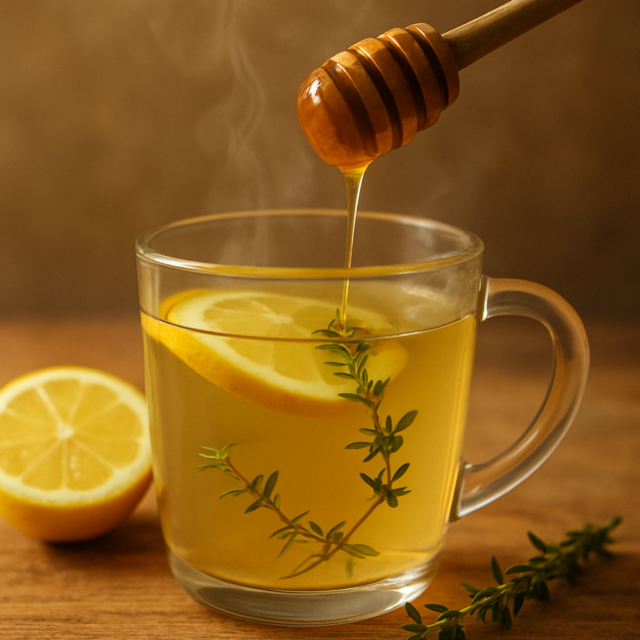
- The comforting infusion: to make a thyme and honey infusion, steep your thyme, let it cool slightly, then add a spoonful of honey and the juice of half a lemon.
- The honey and lemon mix: the classic duo for a cough. In a mug, mix the juice of half a lemon with a spoonful of honey, add a little warm water and sip slowly. The lemon brings its vitamin C and cleansing acidity, the honey its protective film: it is the simplest home-made syrup there is.
As for dosage, keep it simple. For an adult, the dose is one to two teaspoons, two to three times a day. For a child over one year old, stick to half a teaspoon, once or twice a day. Our article which honey for a cough in children? details the precautions.
Important: why you must NEVER give honey to babies
This age limit is an absolute safety rule. The danger of honey for babies under 12 months is linked to a rare but serious illness: infant botulism. Honey, even pure honey, can contain the spores of a bacterium.
In an adult or an older child, the mature digestive system neutralises these spores without difficulty. A baby’s digestive system, however, is not yet equipped to defend itself, which allows the spores to develop and release a dangerous toxin.
After the age of one, the risk disappears. Giving honey to a 2-year-old with a cough is therefore perfectly safe, as long as you respect the doses. Knowing this rule is a cornerstone of food safety for babies.
How to choose your honey for maximum effectiveness
When buying, look for the words “raw honey” or “cold-extracted”. An industrial honey is often heated, which destroys a large part of its benefits. A less processed product is a natural honey that is genuinely active. That is the case with all our honeys, harvested in Provence and never pasteurised.
Origin is also a crucial clue. Choose a honey that clearly states its floral and geographical origin (e.g. “thyme honey harvested in Provence”) rather than a vague label such as “blend of EU and non-EU honeys”. Our article how to recognise a quality honey? gives you all the criteria.
To choose your honey well, keep this list in mind:
- Check the origin: a single country or a specific region.
- Look for the words: “raw honey”, “unpasteurised” or “cold-extracted”.
- Favour local beekeepers: often the best guarantee of quality.
In short: your natural care routine for a cough
You now know that each jar of honey has specific properties. In short: for a dry, irritating cough or a sore throat, think of thyme honey; for a sensitive throat, lavender honey; for a chesty cough that needs clearing, choose eucalyptus or forest honey.
For this natural remedy to be fully effective, remember two essential rules. First, always add honey to a warm drink, never a boiling one, to preserve its qualities. Second, and this is the most important point, never give honey to a child under one year old.
Think of honey as your first line of defence, a valuable aid that does not replace medical advice. If a cough lasts more than a few days, gets worse or comes with a fever, see your doctor.
Frequently asked questions
What is the best honey for a cough?
Thyme honey, thanks to its high thymol content, a natural antiseptic. It calms a dry cough, cleanses the throat and relieves night-time coughing fits. For a chesty cough, choose eucalyptus or a forest honey.
Which honey for a sore throat?
Thyme honey for very painful throats, lavender honey for sensitive throats and for children. Let a teaspoon melt in your mouth several times a day.
Are honey and lemon effective for a cough?
Yes: it is the classic home-made syrup. The honey coats and soothes the throat, the lemon brings vitamin C and cleansing acidity. Mix a spoonful of honey and the juice of half a lemon in warm (never boiling) water.
Can you give honey to a child with a cough?
Yes, from the age of one (half a teaspoon, once or twice a day), but never before 12 months because of the risk of infant botulism.
Is honey a cough suppressant or an expectorant?
Both, depending on the honey: all honeys have a mechanical cough-suppressant effect (the protective film that calms irritation), and some, such as eucalyptus or fir, are traditionally used for their expectorant effect, which helps to clear the airways.