
Fake Honey: How to Recognise Genuine Quality Honey
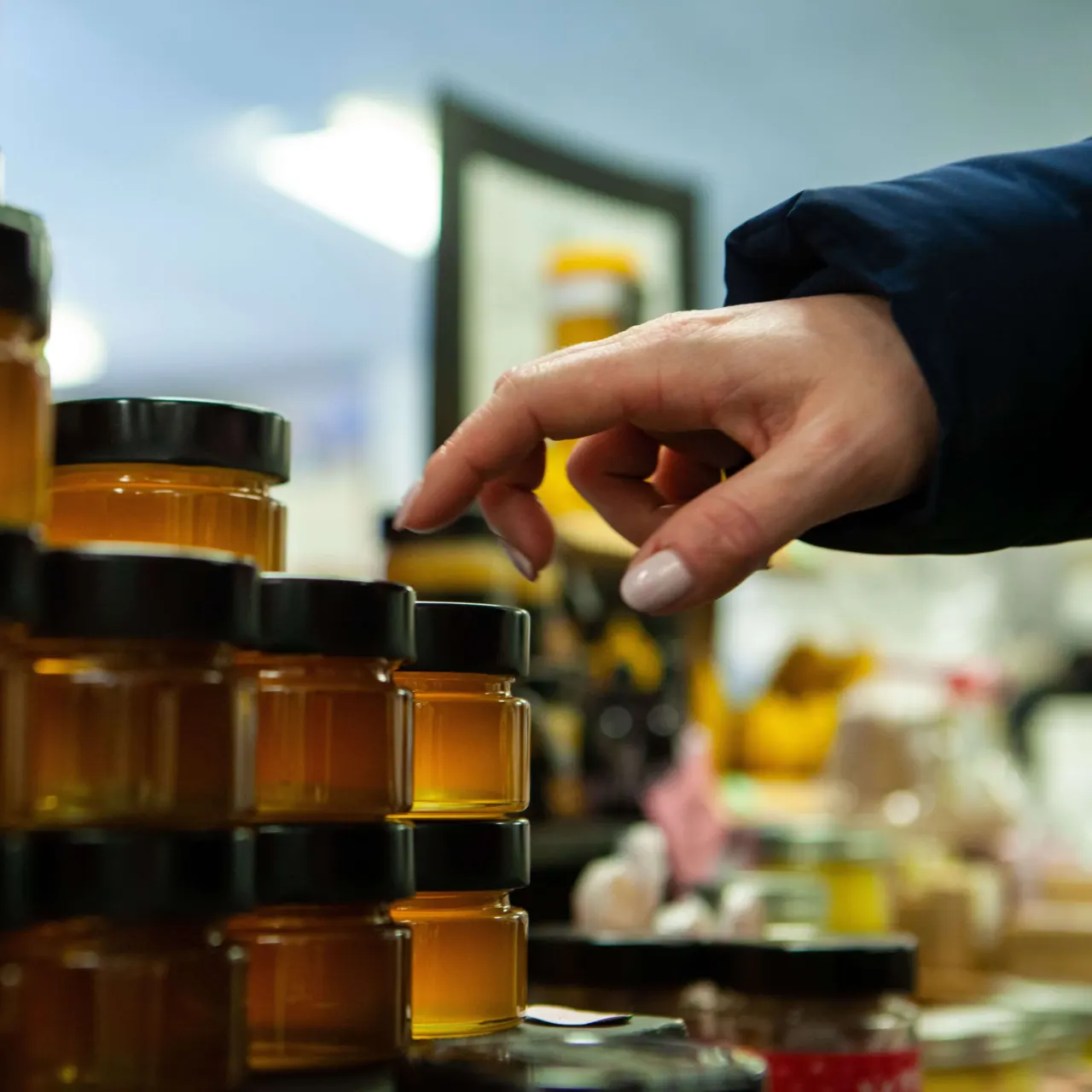
A “fake honey” is most often a honey cut with sugar syrups, or a honey whose stated origin is not the real one. At home, no test can expose it with certainty: only laboratory analyses can. To buy a genuine quality honey, rely instead on the label, the price per kilo, how the honey behaves over time and how transparent the seller is.
What do we mean by fake honey?
In regulatory terms, honey is a substance produced by bees from the nectar of flowers or from honeydew, to which no ingredient may be added. A product that does not meet this definition cannot be sold as honey. In practice, the term “fake honey” covers several kinds of fraud.
- Added syrups: rice, corn, beet or cane syrups, sometimes engineered to mimic the composition of honey and slip past routine analyses.
- Feeding colonies during the honey flow: bees fed on syrup at the very moment they should be foraging can produce a honey diluted with sugar.
- A misleading origin: an imported honey presented as French, or a blend in which some of the origins go unmentioned.
- The wrong flower on the label: a honey sold as lavender, for example, when it comes mainly from other blossoms.
This is not a marginal problem. In 2023, the European Commission published the results of a coordinated control action on honey imported into the Union: a significant share of the samples analysed was found to be suspected of not complying with the rules, most often because of a presumed addition of sugar syrups. These checks do not target any particular country or brand; they are a reminder that traceability matters.
How do you read the label on a jar of honey?
The label does not prove everything, but it already removes a good deal of uncertainty. Here are the mentions to look for.
| Mention | What it means | What to take from it |
|---|---|---|
| “Harvested in France”, a region or a town | The country of harvest, which is mandatory, sometimes given in more detail | The more precise the origin, the more real the traceability |
| “Blend of EU and non-EU honeys” | A blend of several origins | A legal mention; read the list of countries and their share when it is given |
| “Filtered honey” | Thorough filtration has removed much of the pollen | Mandatory in this case; without pollen, the origin is harder to verify |
| “Baker’s honey” | A honey intended for cooking or industrial use | It is not a honey for tasting on its own |
| “Cold-extracted”, “unpasteurised”, “raw” | A honey that has supposedly not been heated | Unregulated terms: their value depends on the seller |
| “Pure honey”, “100% natural” | Nothing more than the legal definition of honey | A sales argument, not a quality criterion |
In France, all the countries of origin in a blend must already appear on the jar, in order of importance. European Directive 2024/1438 extends this transparency across the Union by providing for the share of each country to be stated. A jar that mentions no country of harvest does not comply with the rules. Finally, “honey preparation”, “honey flavour” or “syrup” do not designate honey.
Can home tests identify fake honey?
No. Online, you will find many tests that are supposed to reveal fake honey in a few seconds. None of them is reliable, and here is why.
- The glass of water test: real honey is supposed to sink to the bottom without dissolving. In reality, any dense, sugary liquid sinks to the bottom, syrup included, and any honey ends up dissolving if you stir. The result depends mainly on viscosity, and therefore on water content and temperature.
- The flame test: a match dipped in real honey is supposed to still light. At best, this test tells you about the honey’s moisture, not its purity. A thick syrup can behave in the same way.
- The thumb test: a drop of real honey is supposed to stay put on your finger. Once again, it is viscosity talking. A naturally runny honey, such as acacia, or a warm honey will run more than a thick syrup.
- Blotting paper, vinegar or iodine: these tests rely on reactions that are not specific to honey and say nothing about any added syrup.
The most common frauds use precisely those syrups that imitate the density and taste of honey. Detecting them requires laboratory analyses: isotopic analysis, chromatography, nuclear magnetic resonance, pollen analysis. Even these methods do not catch every adulteration, which is why traceability matters so much.
Is crystallisation proof of real honey?
It is a clue, not proof. Most raw honeys end up crystallising, more or less quickly depending on their ratio of glucose to fructose: lavender, rapeseed or sunflower within a few weeks, acacia or chestnut much more slowly. Our page on raw, unpasteurised honey explains what heating changes.
A honey that crystallises finely and evenly is therefore reassuring. Conversely, a lavender honey that has stayed perfectly liquid for a year has probably been heated, which does not make it a fake honey. And a product cut with syrup can also partly crystallise. Crystallisation tells you how the honey has been handled, rarely whether it is pure.
Can the price give away a fake honey?
Price is another clue. Producing honey in France is expensive: looking after the colonies, moving hives from one bloom to the next, harvests that vary greatly with the weather. As a rough guide, a wildflower honey harvested in France often sells for between €12 and €20 per kilo, and rare monofloral honeys such as lavender or thyme often for between €30 and €60 per kilo from producers and delicatessens.
A cheap honey is not necessarily a fake honey: most often it is a legal blend of imported honeys, simply less distinctive. But a honey presented as French, or as a rare single-flower honey, and sold well below these levels deserves a question. Our article on the price of honey per kilo looks at these differences in detail.
Do labels guarantee real honey?
Official quality signs provide specific guarantees, checked by independent bodies. The organic label (Agriculture Biologique in France) governs the environment of the hives and the way colonies are managed. Geographical indications, such as the Miel de Provence PGI, or designations of origin, such as the Miel de Corse PDO, define an area and a set of specifications. Label Rouge singles out certain honeys for their superior quality.
These are useful markers, among others. Many serious honeys carry no label at all, and a label does not tell you everything about a honey’s taste or freshness. The honeys we offer, for example, are neither certified organic nor PGI: we prefer to say so clearly and to state the origin and extraction method of each one.
Where can you buy real, quality honey?
The best safeguard against fake honey remains a transparent seller. Whether you buy from a beekeeper, at a market, in a delicatessen or online, ask the same questions.
- Where was the honey harvested, and in what season?
- Who harvested it, and who put it in the jar?
- Has it been heated, finely filtered or blended?
- What justifies its price?
A serious producer or selector answers precisely; on a website, this information should appear on the product page. Our guide to recognising artisan honey explores these criteria further. As an example, our thyme honey harvested in Provence is selected each year from partner beekeepers; it is raw, cold-extracted, never pasteurised or blended, and sold at €15 for a 300 g jar, or €50 per kilo.
Frequently asked questions
How can you tell if a honey is fake?
At home, you cannot prove it. Read the origin and the mentions on the label, compare the price per kilo, watch whether the honey crystallises over time and ask the seller questions. Only laboratory analyses can establish that syrup has been added.
Is the glass of water test reliable?
No. A dense syrup sinks to the bottom of a glass of water just like real honey, and any honey ends up dissolving if you stir. This test tells you about viscosity, which depends on water content and temperature, not about purity.
Is a honey that does not crystallise a fake honey?
Not necessarily. Some honeys, such as acacia or chestnut, naturally stay liquid for a long time. For a honey that usually crystallises quickly, like lavender, permanent runniness points to heating rather than fraud.
Is supermarket honey fake honey?
No, not as a general rule. Most supermarket honeys are real honeys, often blends of several origins, sometimes heated and filtered. They are simply less traceable than a honey from a specific terroir.
What does “filtered honey” mean?
It refers to a honey from which a large share of the pollen has been removed by thorough filtration, and the rules then require this mention. It is not a fake honey, but its origin is harder to verify in the laboratory.