
Manuka Honey: Origin, MGO and UMF Grades, Price and an Honest Comparison
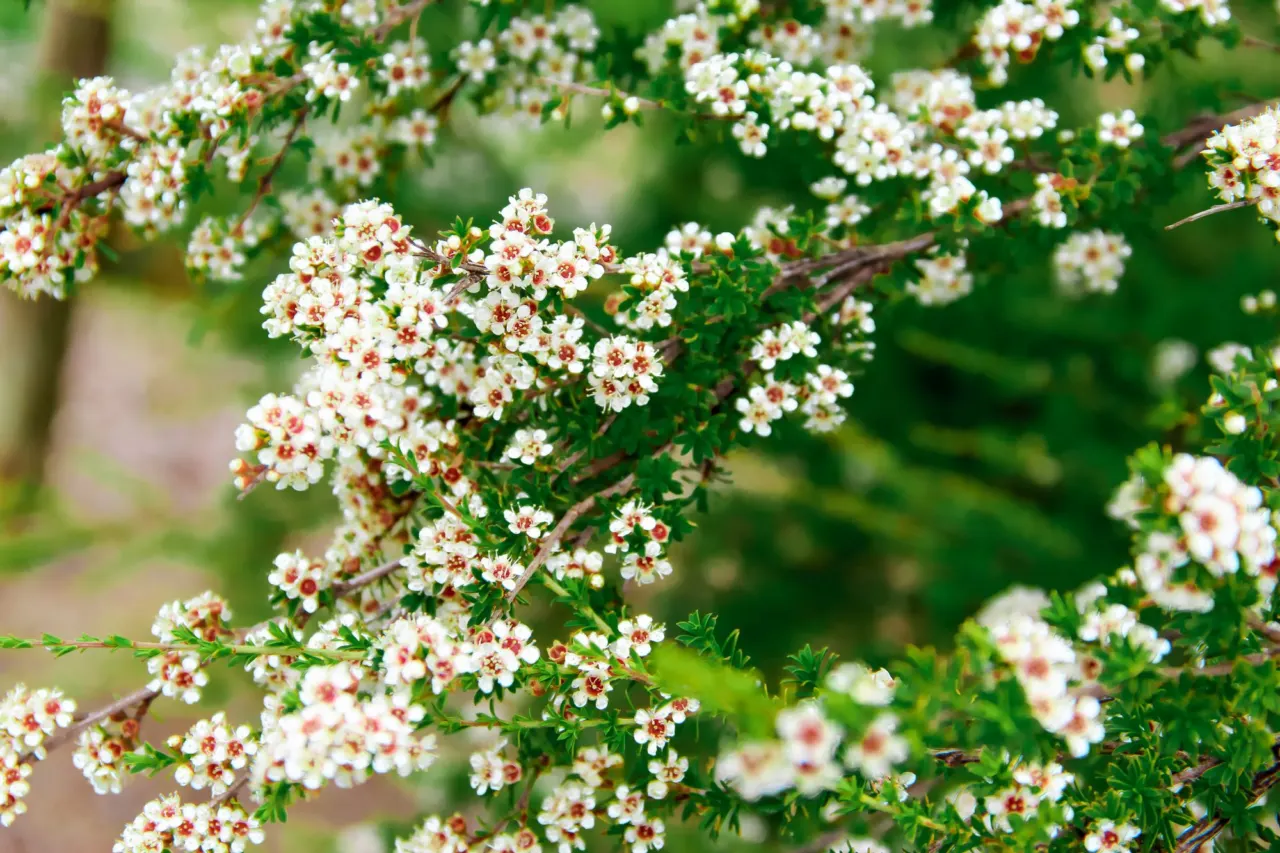
Manuka honey is harvested in New Zealand and south-eastern Australia from the flowers of manuka, Leptospermum scoparium, a shrub of the myrtle family. It stands out for its methylglyoxal (MGO) content, a molecule studied for its antibacterial activity, which is measured by the MGO and UMF grades shown on the jars. It often costs two to ten times as much as a good European honey, a gap that owes far more to its scarcity, its testing and its market than to its flavour.
What is manuka honey?
Manuka honey is a monofloral honey made by bees from the nectar of manuka, Leptospermum scoparium, a shrub or small tree of the Myrtaceae family. It grows wild in New Zealand, on hillsides, cleared land and forest edges, as well as in south-eastern Australia. Its name comes from the Māori language.
Its white or pinkish flowering is short: a few weeks at the start of the southern summer, most often between November and January depending on the region.
On tasting, manuka is a creamy brown to dark brown honey, thick, almost jelly-like. It is described as thixotropic, like ling heather honey: it becomes runny when stirred, then firms up again at rest. Its flavour is powerful, earthy and slightly bitter, with notes of caramel and dried herbs that some find “medicinal”.
In Australia, other Leptospermum species produce similar honeys, sold as Australian manuka, and the use of the name has set New Zealand and Australian producers against each other for several years. To regulate its exports, New Zealand has applied an official scientific definition since 2018: a honey exported as manuka must show four chemical markers and a DNA marker from manuka pollen, with a distinction between monofloral and multifloral manuka.
What do the MGO and UMF grades mean?
Most jars of manuka show a number followed by a “+”. This number refers to methylglyoxal, or MGO, a molecule found in unusual quantities in this honey. It comes from the dihydroxyacetone (DHA) in manuka nectar, which slowly turns into methylglyoxal as the honey matures and is stored. In 2008, researchers at the Technical University of Dresden, in Germany, identified it as the main source of manuka’s particular antibacterial activity.
- MGO: the methylglyoxal content, expressed in milligrams per kilo. “MGO 100+” means at least 100 mg/kg.
- UMF (Unique Manuka Factor): a certification mark managed by an association of New Zealand producers. Its scale, from 5+ to 20+ and beyond, reflects the MGO content, and the certification also checks the honey’s authenticity, using a marker specific to manuka, leptosperin, as well as its freshness.
- Other labels: some brands use their own scales or terms such as “active” or “bioactive”. Without a verifiable MGO or UMF figure, these labels are hard to compare.
The two scales overlap. Here are the equivalences most often given by sellers, with price ranges seen in France:
| UMF grade | Approximate MGO equivalent | Price often seen (250 g jar) |
|---|---|---|
| UMF 5+ | MGO 83+ | about €20 to €35 |
| UMF 10+ | MGO 263+ | about €35 to €55 |
| UMF 15+ | MGO 514+ | about €60 to €100 |
| UMF 20+ | MGO 829+ | often over €100 |
These prices are guidelines, not statistics: they vary with the brand, the sales channel and special offers. A higher grade does not make the honey taste better; it simply indicates a higher MGO content.
Does manuka honey have special properties?
All honeys show antibacterial activity in the laboratory. It comes from their high sugar concentration, their acidity and above all the hydrogen peroxide slowly produced by an enzyme added by the bees, glucose oxidase.
Manuka stands out because a large part of its activity comes from methylglyoxal, which withstands heat better than peroxide: this is known as “non-peroxide” activity. Medical-grade, sterilised manuka honeys are therefore used in dressings for certain wounds, as medical devices. These products are not jars of table honey.
For honey eaten by the spoonful, the evidence is thinner. A Cochrane review published in 2018 concluded that honey can probably relieve acute cough in children over one year old better than no treatment, but the studies concern honey in general, not manuka in particular; we cover this in our article on which honey to choose for a cough. The effects attributed to manuka on digestion or immunity are, to date, poorly demonstrated in humans.
Finally, manuka is still a honey: about 80 g of sugars per 100 g, like any other. It must never be given to a child under one year old, because of the risk of infant botulism. People with diabetes, pregnant women and people on medical treatment should ask their doctor’s advice before taking it as a “course”.
Why is manuka honey so expensive?
A 250 g jar of MGO 100+ manuka often costs around €25 to €35, or €100 to €140 per kilo, and high grades frequently exceed €300 per kilo. By comparison, most honeys sold in France cost between €5 and €50 per kilo, as we explain in our article on the price of honey per kilo.
- A limited resource: flowering is short and weather-dependent, and manuka areas are often remote.
- Batch-by-batch testing: every batch exported as manuka must be tested against New Zealand’s official definition, and MGO or UMF grades require further analysis.
- Maturing: MGO increases slowly during storage, and some producers keep the honey for several months to reach the target grade.
- Strong global demand: manuka is sold in Asia, North America and Europe as a prestige product, with brands, packaging and marketing that all have a cost.
- Transport: more than 18,000 km separate New Zealand from France.
The price has also attracted fraud: in the 2010s, checks found honeys on sale as manuka that did not show its markers. To buy with confidence, check that the jar states a country of harvest, a numbered MGO or UMF grade and a batch number, and prefer a honey jarred in its country of origin. Our general guidelines for recognising a quality honey also apply.
Manuka, thyme or chestnut: how do they compare?
Comparing manuka with honeys harvested in Provence only makes sense if it is done honestly: these are different honeys that meet different expectations. Manuka offers a numbered guarantee of methylglyoxal, specific to Leptospermum honeys; thyme and chestnut offer a distinctive flavour, everyday use in cooking and a shorter supply chain.
| Criterion | Manuka honey | Thyme honey | Chestnut honey |
|---|---|---|---|
| Origin | New Zealand, south-eastern Australia | Garrigue and limestone hills of Provence, in spring | Chestnut woods of Provence, such as the Maures, in June and July |
| Colour and texture | Creamy brown to dark brown, thick, almost jelly-like | Amber, runny then crystallised | Dark brown, stays runny for a long time |
| Flavour | Powerful, earthy, slightly bitter, caramel notes | Aromatic, herbaceous, spicy | Woody, tannic, pronounced bitterness |
| Guaranteed grade | MGO or UMF, laboratory-tested | No standardised grade | No standardised grade |
| Common uses | By the spoonful, on toast, in a warm drink | Herbal teas, yoghurt, goat’s cheeses, roast meats | Strong cheeses, spiced honey bread, sauces, chutneys |
| Indicative price | Often from €80 to over €400 per kilo depending on the grade | €15 for a 300 g jar at Miellerie de Provence, or €50 per kilo | €15 for a 300 g jar at Miellerie de Provence, or €50 per kilo |
| Supply chain | Imported from the other side of the world | Harvested in Provence by partner beekeepers, jarred in Aix-en-Provence | Harvested in Provence by partner beekeepers, jarred in Aix-en-Provence |
For flavour, manuka is closer to dark honeys than to floral ones. If you like it, chestnut honey will probably appeal to you: it shares that power and slight bitterness, with clearer woody notes. Like most dark honeys, it is among the richest in minerals and phenolic compounds; we go into this in the benefits of chestnut honey.
For winter, thyme honey is traditionally added to herbal teas and hot drinks in Provence. It has no standardised grade, and we do not claim that it works like manuka: it is an aromatic, amber honey at a gentler price, and we know exactly where it was harvested.
For your budget, for the price of a 250 g jar of mid-grade manuka, you can often buy two to four 300 g jars of thyme or chestnut honey. Manuka still makes sense if you are looking specifically for its methylglyoxal content; for cooking or serving with cheese, a characterful honey harvested closer to home is just as suitable.
Miellerie de Provence does not sell manuka honey. Each year we select six honeys harvested in Provence by partner beekeepers, including thyme and chestnut, all raw, cold-extracted, never pasteurised and never blended. They carry no grade and no spectacular promise: just the taste of a bloom and a terroir, and an origin we can tell you precisely.
Frequently asked questions
What is the difference between MGO and UMF?
MGO is the honey’s methylglyoxal content, in milligrams per kilo. UMF is a New Zealand certification that expresses this content on a different scale and also checks the honey’s authenticity and freshness. UMF 10+ corresponds roughly to MGO 263+.
Which manuka grade should you choose?
For the table, a low grade, around MGO 100+ or UMF 5+, is enough: a higher grade does not change the flavour and costs much more. High grades are only worthwhile if you are looking specifically for a high methylglyoxal content; for any health-related use, ask your doctor or pharmacist for advice.
Is manuka honey produced in France?
Not on a commercial scale, as far as we know. Manuka is native to New Zealand and Australia, and the manuka honey sold in France is imported. In France, the dark, powerful honeys closest in flavour are chestnut, heather and forest honeys.
Can you give manuka honey to a child?
Not before one year old, like any honey, because of the risk of infant botulism. After one year, it can be eaten in small amounts like other honeys; for any health-related use, ask your paediatrician for advice.