
Best Lavender Honey: How to Choose It and Where to Buy It
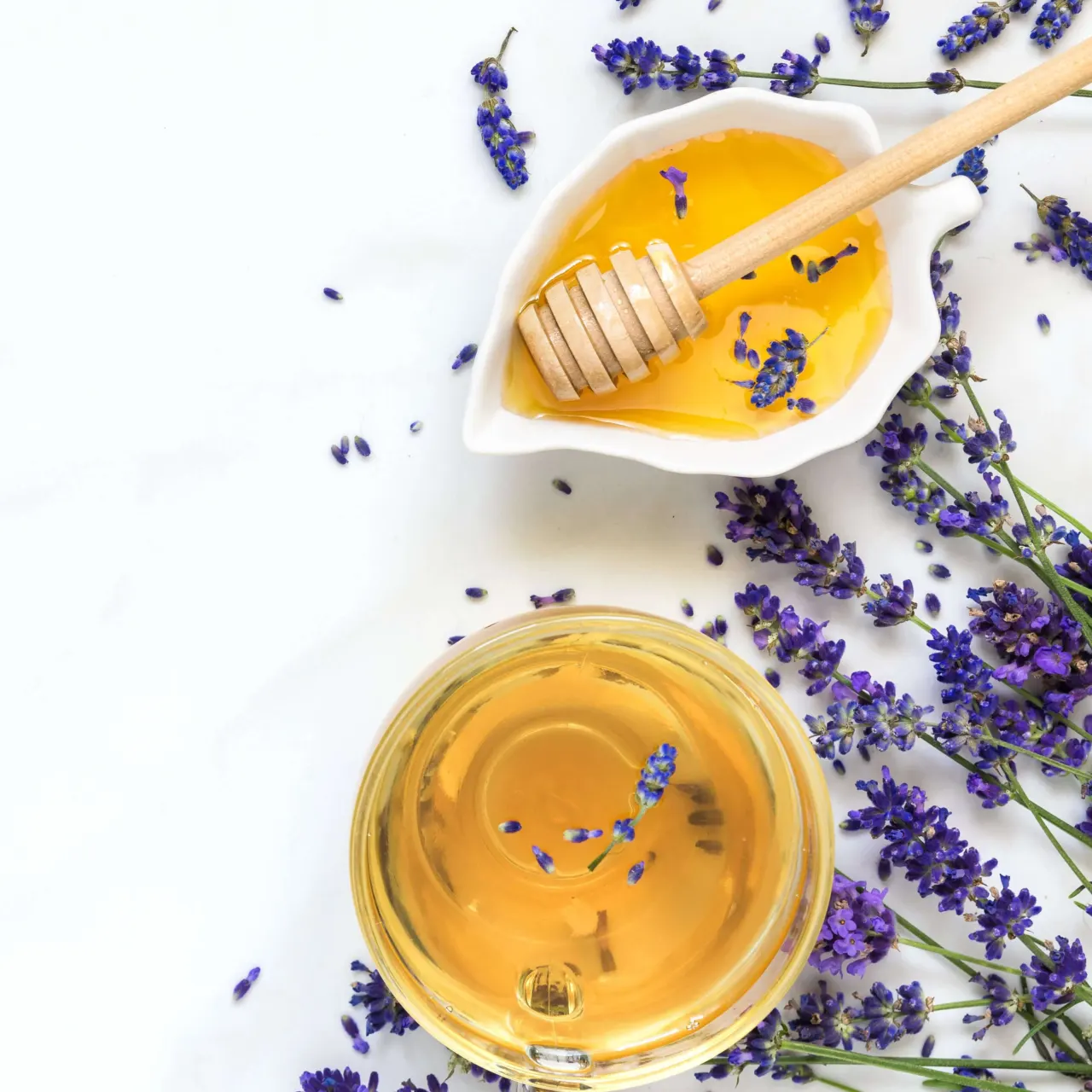
The best lavender honey is not a brand: it is a honey whose origin you know, harvested in summer on the plateaus of Haute-Provence, cold-extracted and unpasteurised. It is pale, with a clean floral fragrance, and crystallises into a fine, creamy texture. To find it, read the label, compare prices per kg and favour sellers who can tell you where and when it was harvested.
What makes a good lavender honey?
Lavender honey is a monofloral honey: during the nectar flow, the bees foraged mainly on lavender or lavandin flowers. The beekeeper sets the hives among the flowering fields, often by moving them there for the season, then harvests just after flowering.
A good lavender honey combines three qualities. First, a clear floral origin: it evokes lavender without smelling of essential oil. Second, a ripe harvest: honey that has been properly capped in the hive contains little water and keeps without difficulty. Finally, gentle handling: cold extraction by centrifuge, settling, and jarring without heating. This is what is known as raw, unpasteurised honey.
True lavender or lavandin: what difference does it make to the honey?
Two plants share the Provençal landscape. True lavender (Lavandula angustifolia), also called fine lavender, grows mainly at altitude, on dry, stony soils. Its clumps are smaller and its yields modest. Lavandin is a hybrid of true lavender and spike lavender. More vigorous and more productive, it covers most of the large fields photographed in July, notably on the Valensole plateau.
Both produce honey. A large share of the honey sold as lavender honey actually comes from lavandin fields, or from both neighbouring blooms. Some labels say so with the words “lavender and lavandin”. This is not a flaw: it is the agricultural reality of the region.
In taste, the differences remain subtle and vary from year to year. Lavandin honey is often described as milder and a little less distinctive; true lavender honey, which is rarer, as more floral and fruity. Both can be of excellent quality, provided the label does not promise more than the jar contains.
| Criterion | True lavender | Lavandin |
|---|---|---|
| Plant | Lavandula angustifolia, wild or cultivated | Hybrid of true lavender and spike lavender |
| Where it grows | Mainly at altitude: Pays de Sault, Albion plateau, Haute-Provence | Lower plateaus and large-scale crops: Valensole, Drôme Provençale |
| Flowering | Mostly in July, into August at altitude | From late June to July |
| Honey volumes | Small, a rare harvest | Larger |
| Profile often described | Floral, fruity, with a tangy finish | Milder, a little less distinctive |
Where is lavender honey harvested in Provence?
The main lavender honey flows take place on the plateaus of Haute-Provence and the surrounding areas. Each has its own character, which you will find on our page about the honey terroirs of Provence.
- The Valensole plateau (Alpes-de-Haute-Provence): the best known, dominated by lavandin, with vast areas in bloom in early July.
- The Pays de Sault (Vaucluse): higher up, at the foot of Mont Ventoux, a land of true lavender where flowering comes later.
- The Albion plateau: straddling the Vaucluse, Alpes-de-Haute-Provence and Drôme, a high limestone plateau where true lavender and lavandin grow side by side.
- The Drôme Provençale and the Baronnies: more scattered plots, between fields and hills.
The name of a plateau on the label is a good sign of traceability, but the taste also depends on the year: drought or the mistral during flowering can sharply reduce the harvest.
When is lavender honey harvested?
The lavender honey flow happens in summer, over a few weeks. Beekeepers place their hives at the edge of the fields in late June or early July, then harvest in July and August, depending on altitude and how far flowering has progressed. On the lowest plateaus, lavandin is often cut from mid-July; at altitude, true lavender flowers for longer.
Jars from the new harvest therefore arrive at the end of summer, when its aromas are at their liveliest.
Colour, texture, taste: how do you recognise lavender honey?
At harvest, lavender honey is runny and pale, between pale yellow and light gold. Fairly rich in glucose, it then crystallises within a few weeks to a few months. It takes on an ivory colour and a fine, creamy texture that spreads without dripping. This change is natural: our article why honey crystallises explains it in detail.
On the palate, it is floral and fragrant, with no bitterness and a length that more neutral honeys lack. If you are hesitating between it and another pale honey, our comparison acacia honey or lavender honey sums up what sets them apart.
How do you read a lavender honey label?
The label is your best tool. Here is what it must, or may, tell you.
- The country of harvest: this is mandatory. “Harvested in France” is a minimum; a region, a plateau or a village is better. The wording “blend of EU and non-EU honeys” signals a mix of several origins, which sits poorly with a terroir honey.
- The flower: “lavender”, “lavandin” or “lavender and lavandin”. An honest detail is worth more than a vague promise.
- The place and year of harvest: optional, they show genuine traceability.
- The process: “cold-extracted”, “unpasteurised”, “raw”. These terms are not regulated; their value depends on how reliable the seller is.
Some honeys also carry an official quality sign. The IGP Miel de Provence (a Protected Geographical Indication), for example, defines a geographical area and a set of specifications, and notably covers lavender and lavandin honey. It is a useful indicator among others. Many quality honeys harvested in Provence do not carry it: a precise label and a transparent seller also offer real guarantees.
How much does a good lavender honey cost?
French lavender honey is among the most expensive honeys produced in France, for a simple reason: lavender yields little nectar and its harvest depends heavily on the weather. As a guide, lavender honey harvested in Provence often sells for €30–60 per kg from producers and in delicatessens. These ranges are observations, not statistics: they vary with the year and the sales channel.
To compare, always work out the price per kg. A 300 g jar at €15 comes to €50 per kg; a 500 g jar at €12 comes to €24 per kg. A lavender honey presented as Provençal and sold well below these ranges deserves a careful reading of the label. Our article on the price of honey per kg explains what lies behind these differences.
Where can you buy lavender honey?
- From a beekeeper, at their honey house or farm: this is the shortest supply chain, and often the most economical. You can ask your questions directly.
- At markets in Provence: ask where the hives were placed and when the honey was harvested. A producer will gladly give you a precise answer.
- In a delicatessen or a regional produce shop: selection and advice come at a cost, but the origin is generally well identified. Check the producer’s name on the jar.
- Online: look on the product page for the place of harvest, the process, the weight and the price.
Our Lavender Honey harvested in Provence is one of these options. We select it each year from partner beekeepers. It is raw, cold-extracted, never pasteurised or blended, and sold at €15 for a 300 g jar, or €50 per kg, shipped from Aix-en-Provence. That is more expensive than honey bought by the bucket at a market: judge it by the same criteria as the others.
Frequently asked questions
What is the best lavender honey?
There is no official ranking. The best lavender honey is one with a precise origin, harvested in Provence during the summer bloom, cold-extracted and unpasteurised, whose seller can tell you the place and year of harvest. The rest is a matter of taste and of the year.
Is lavandin honey real lavender honey?
It comes from the flowering of a cultivated lavender, lavandin, a hybrid of true lavender and spike lavender. Its honey is often a little milder and less distinctive than true lavender honey, which is rarer. An honest label states “lavender”, “lavandin” or “lavender and lavandin”.
How much does lavender honey cost?
As a guide, lavender honey harvested in Provence often sells for €30–60 per kg from producers and in delicatessens. Always compare the price per kg and the stated origin.
Is lavender honey suitable for children?
Its mild, floral taste often appeals to children, but only from one year old. Before 12 months, no honey should be given, because of the risk of infant botulism.