
5 Indulgent Honey Dessert Ideas
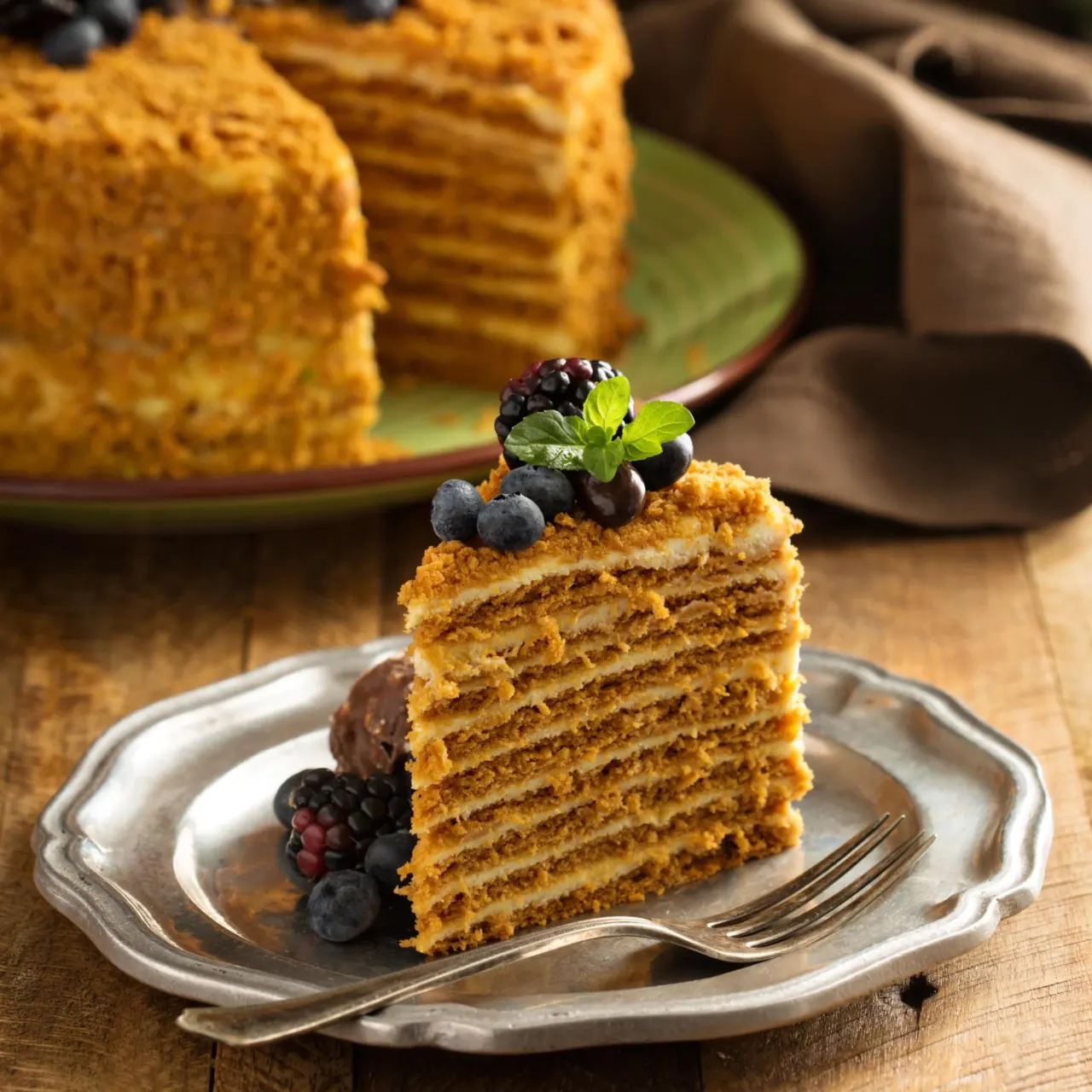
Honey in baking is far more than a sugar substitute: it is an ingredient that brings moistness, aroma and a depth that white sugar will never give. The secret of successful honey desserts? Match the variety of honey to the recipe, just as you would match a wine to a dish. Here are our 5 favourite desserts at the miellerie, each with the honey that shows it at its best.
Summary
- Choose honey as an ingredient in its own right: mild (lavender) for delicate desserts, strong (chestnut) for rustic ones.
- Honey adds moistness; use 70 g for every 100 g of sugar replaced.
- Add it at the end of cooking, or cold, whenever possible, to preserve its aromas.
- Lower the oven by 10–15 °C: honey browns faster than sugar.
1. Honey and walnut tart
The ultimate comfort dessert: a shortcrust base and a melting filling in which honey coats toasted walnut halves, a Provençal take on pecan pie.
The right honey: chestnut honey, whose woody notes and hint of bitterness are a perfect match for walnuts.
The recipe in brief: melt 150 g of honey with 50 g of butter and 100 ml of cream, pour over 200 g of walnut halves spread over a blind-baked pastry case, and bake for 20–25 minutes at 165 °C. Leave to cool slightly before slicing.
2. Lavender honey crème brûlée
The bistro classic with a taste of terroir: a smooth, honey-scented custard, a crisp caramelised crust, and Provence in every spoonful.
The right honey: lavender honey, of course: its floral fragrance infuses the cream without ever overpowering it.
The recipe in brief: replace the sugar in your classic crème brûlée with 80 g of lavender honey for 500 ml of cream and 5 egg yolks. Bake gently in a bain-marie (150 °C, about 40 minutes), chill, then caramelise with a blowtorch just before serving.
3. Home-made pain d’épices
THE honey dessert par excellence: in this French honey spice bread, honey is not just an ingredient, it is the star. The traditional recipe calls for as much honey as flour.
The right honey: chestnut for a pain d’épices with character, or forest honey for incomparable malty notes.
The recipe in brief: 250 g of warmed honey, 250 g of flour (half rye if possible), 1 sachet of baking powder, 100 ml of milk, 1 egg, and your spices (cinnamon, ginger, star anise, nutmeg). Bake at 160 °C for 50 minutes, and be patient: it is even better the next day.
4. Honey ice cream with caramelised walnuts
The pleasant surprise: honey improves the texture of home-made ice cream (it lowers the freezing point, so there are fewer ice crystals and more creaminess).
The right honey: mountain honey, rich enough to stay present when cold (cold dulls aromas).
The recipe in brief: a custard (crème anglaise: 500 ml of milk, 4 egg yolks) sweetened with 120 g of honey, churned, then scattered with honey-caramelised walnuts. No ice-cream maker? Pour into a container and whisk every 30 minutes while it sets.
5. Honey and speculoos tiramisu
The fusion that works: the roundness of mascarpone, the spiced-biscuit notes of speculoos, and honey in place of sugar. The result: a tiramisu that is more aromatic and less sweet.
The right honey: garrigue honey, whose warm notes echo the spices of the speculoos.
The recipe in brief: whisk 3 egg yolks with 80 g of honey, fold in 250 g of mascarpone, then the whisked egg whites. Build up in layers with speculoos biscuits dipped in lukewarm coffee sweetened with honey. At least one night in the fridge.
The 3 golden rules of baking with honey
- The quantity: 70 g of honey replaces 100 g of sugar, and reduce the liquids by about 20 ml per 100 g of honey. All the conversions are in replacing sugar with honey;
- The temperature: lower the oven by 10–15 °C, as honey caramelises faster;
- The quality: in baking as elsewhere, a raw honey with character makes all the difference; a flat industrial honey makes a flat dessert. Choose from our honeys harvested in Provence to suit the recipe.
Fancy exploring savoury dishes too? Our Recipes section brings together all our honey ideas, from aperitifs to desserts.
Frequently asked questions
Which honey should you use for desserts?
Mild honeys (lavender, mountain) for delicate desserts (custards, panna cotta, ice cream); strong honeys (chestnut, forest, garrigue) for rustic desserts (pain d’épices, walnut tarts, speculoos).
Can you replace all the sugar with honey in baking?
Yes, in most recipes: 70 g of honey for 100 g of sugar, reducing the liquids and the oven temperature slightly. For meringues and macarons, however, sugar remains essential to the structure.
Does honey lose its benefits when cooked?
Its enzymes do, in part; its aromas and minerals hold up better. For the maximum health benefit, use honey cold; for pleasure, baking with it is still a delight.
How do you stop a honey cake from browning too much?
Lower the oven by 10–15 °C compared with the sugar recipe, and cover with foil towards the end of baking if it is colouring too quickly.