
Crystallised Honey: Why It Happens and How to Make It Runny
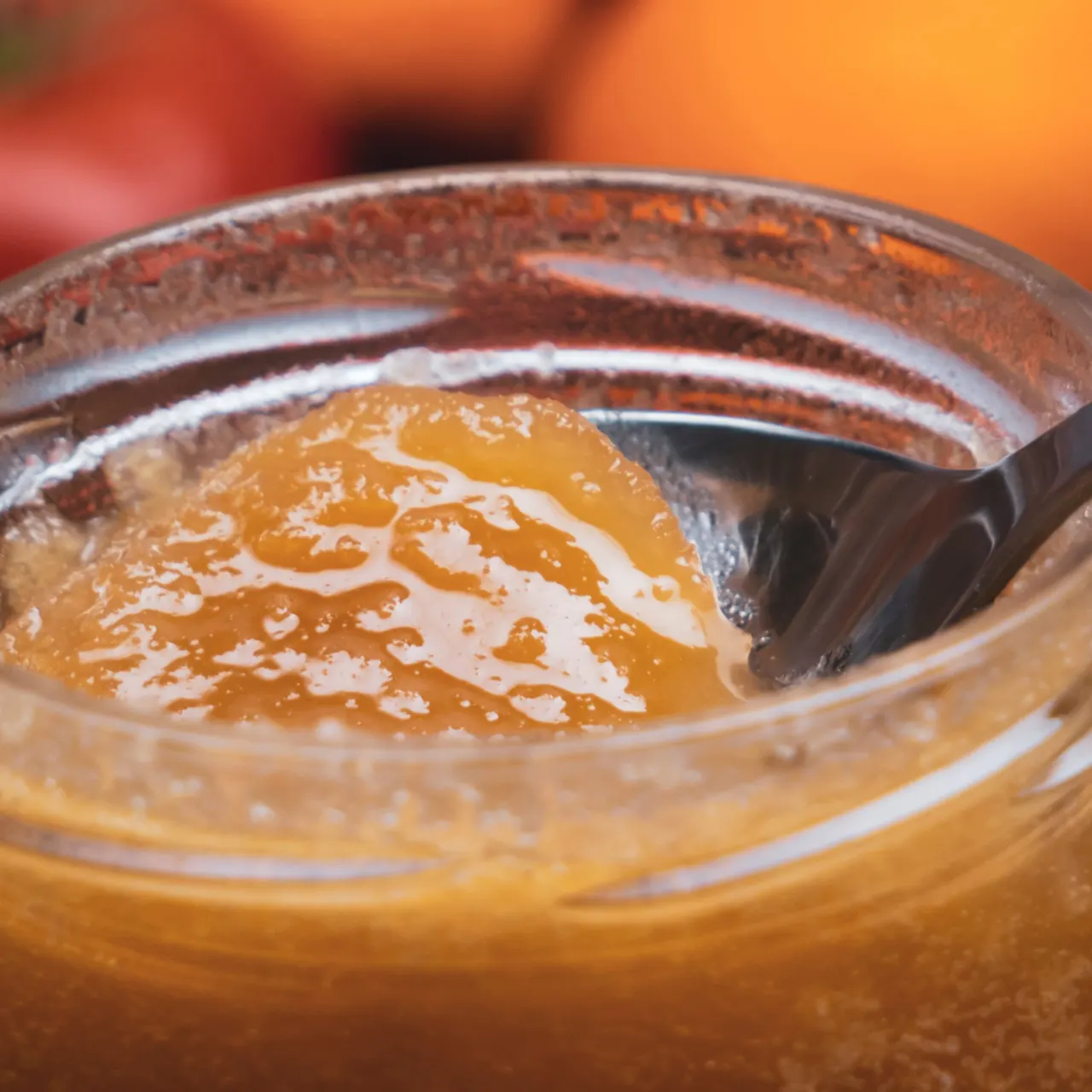
Crystallised honey is neither out of date nor spoiled: crystallisation is a natural process, and often the sign of a raw honey that has not been heated. To get runny honey again, all you need is a gentle bain-marie, below about 40 °C, without ever letting it boil. Here is why honey hardens, how quickly it does so depending on the flowers, and how to make it runny without losing its aromas.
Why does honey crystallise?
Honey is made up of about 80% sugars and 17–18% water. That is far more sugar than this water can keep stably dissolved: it is what is known as a supersaturated solution. Over time, some of the sugar leaves the liquid state and forms crystals. The honey becomes thick, then firm. Crystallised honey (crystallized, in American spelling) is simply honey that has followed this natural course.
Three factors decide how fast and how fine this crystallisation will be.
- The ratio of glucose to fructose. These are the two main sugars in honey. Glucose is not very soluble and crystallises easily; fructose stays liquid much longer. A honey rich in glucose sets quickly, a honey rich in fructose stays runny. This ratio depends on the flowers the bees have visited.
- Temperature. Crystallisation is fastest at around 14 °C. A jar kept in a cool room or near a window in winter therefore hardens faster than one kept at about 20 °C.
- Natural seeds. Pollen grains, tiny crystals already present and fine particles of wax act as nuclei around which crystals form. A raw honey, simply strained to remove debris, naturally contains them. An industrial honey that has been heated and then very finely filtered has lost most of them, which delays its crystallisation.
That is why a honey that crystallises is rather a good sign: it has kept its original structure. The six honeys we select are raw, cold-extracted and never pasteurised, and most of them end up crystallising over the months.
Which honeys crystallise quickly, and which slowly?
Each honey has its own pace. The indications below are tendencies: they vary with the harvest, the year and the storage temperature.
| Honey | Crystallisation speed | Usual texture |
|---|---|---|
| Rapeseed | Very fast (a few days to a few weeks) | Firm and very fine |
| Lavender | Relatively fast (a few weeks to a few months) | Fine and creamy, ivory in colour |
| Garrigue (wild Mediterranean scrubland) | Relatively fast | Fine to medium, smooth |
| Thyme | Medium | Fine |
| Mountain | Variable, depending on the high-altitude flora | Fine to medium |
| Forest (honeydew from oaks and pines) | Slow | Stays thick and fluid for a long time |
| Chestnut | Slow (a fructose-rich honey) | Stays liquid for many months |
| Acacia | Very slow | Can stay liquid for more than a year |
Acacia and lavender illustrate the two extremes well: one stays clear for a very long time, the other sets within a few months. We compare them in detail in acacia honey or lavender honey.
A useful rule of thumb: a “wildflower” honey that has stayed perfectly clear for years, without being acacia or a naturally fructose-rich honey, has often been heated or very finely filtered.
Is crystallised honey still good?
Yes. Crystallisation only changes the texture. The taste, the sugars and the other components of the honey remain the same; the aromas simply unfold more slowly in the mouth. Crystallised honey keeps just as well as runny honey, as we explain in does honey go off?
Two things are normal and harmless:
- white streaks along the glass, sometimes called “frosting” or “bloom”: these are tiny air bubbles trapped between the crystals;
- a thin, more liquid layer on the surface of a coarsely crystallised honey, as long as it does not smell unusual.
Crystallisation or fermentation: how can you tell the difference?
Fermentation is a different process. It occurs when honey contains too much water, for example if it was harvested before it was ripe or if it has absorbed moisture in a poorly closed jar. The yeasts naturally present then multiply. The signs are clear: a sour or alcoholic smell, foam or bubbles on the surface, a sharp, fizzy taste. A crystallised honey, by contrast, simply smells of honey. If it has fermented, it is best not to eat it as it is.
How do you make crystallised honey runny without damaging it?
The safest method is also the simplest: gentleness and a little patience.
- Remove the lid and place the glass jar in a pan of warm water, below about 40 °C. The water should feel hot to the touch, without burning.
- Let the honey warm up slowly, stirring from time to time with a clean, dry spoon.
- Replace the warm water when it cools. Allow from 30 minutes to over an hour for a 300 g jar, depending on how firm the honey is.
- Close the jar again once the honey is back at room temperature, so that it does not absorb moisture.
For a small amount, spoon a little into a bowl set over a warm bain-marie. It is better to liquefy only what you need: every heating, however gentle, wears down the aromas a little. The honey will crystallise again over time, and that is normal.
What to avoid
- The microwave: it heats unevenly and creates very hot spots at the heart of the honey, even when it seems warm overall.
- Boiling water, or a pan placed directly on the heat.
- Prolonged heating, even at a moderate temperature, for hours.
Why does heat damage honey?
Honey contains enzymes added by the bees, such as invertase and diastase, as well as volatile aromatic compounds. These are sensitive to heat. The higher the temperature and the longer the heating, the more the aromas evaporate and the more the enzymes break down. Heat also raises the level of HMF (hydroxymethylfurfural), a molecule used as an indicator of heating or ageing: European regulations in fact set a limit for it in honey. A strongly heated honey remains sweet, but it loses much of what gave it its character.
Creamed honey: crystallisation under control
Creamed honey is not a separate product: it is a honey whose crystallisation has been guided to produce very fine crystals. The classic method is to seed a runny honey with a small amount of honey that has already crystallised finely, stir it, then leave it to set somewhere cool, at about 14 °C. The crystals then form all at once and stay tiny. The result is a soft, spreadable texture that does not run off the spoon.
Some honeys lend themselves to this naturally. Lavender honey often crystallises of its own accord into a fine, creamy texture, without any intervention. Many people enjoy it this way, on toast or in yoghurt. Runny, a honey releases its aromas faster; crystallised, it makes them linger on the palate.
How should you store honey to limit crystallisation?
You cannot stop a raw honey from crystallising, but you can avoid speeding up the process and preserve its quality.
- At a stable room temperature, ideally between 18 and 24 °C, away from any heat source. If you prefer runny honey, avoid cool rooms.
- Not in the fridge: cold hardens honey and does nothing to help it keep.
- In a tightly closed jar: honey absorbs moisture from the air, which encourages fermentation.
- Away from light, in a cupboard.
- With a clean, dry spoon, so as not to add water or crumbs.
Frequently asked questions
Why has my honey gone hard?
Because the glucose it contains has naturally formed crystals. This is the normal behaviour of a raw honey, speeded up by cool temperatures, around 14 °C. It is neither a flaw nor a sign that the honey has gone off.
Is crystallised honey still good to eat?
Yes. Only the texture changes: the taste and qualities of the honey are preserved. Just be wary of a sour smell or foam on the surface, which signal fermentation caused by too much water.
How do you make honey runny without damaging it?
Place the open jar in a warm bain-marie, below about 40 °C, and stir from time to time until it becomes fluid again. Avoid the microwave and boiling water, which damage its aromas and enzymes.
What is the difference between crystallised honey and creamed honey?
Creamed honey is a crystallised honey with very fine crystals, either naturally, as is often the case with lavender honey, or because its crystallisation has been guided by seeding and stirring. It is spreadable and does not run.
Should honey be kept in the fridge?
No. Honey keeps at room temperature, in a tightly closed jar and away from light. Cold hardens it without helping it keep any better.