Honey recipeDesserts & teatime
Provençal Black Nougat with Honey
Provençal black nougat, made with nothing but honey and almonds cooked together until caramelised, with no egg whites, and set between two sheets of edible wafer paper. A crunchy, amber confection and one of the thirteen Christmas desserts.
- Preparation15 min
- Cooking25 min
- Resting2 h
- Makes1 slab of 20 x 20 cm, about 30 pieces
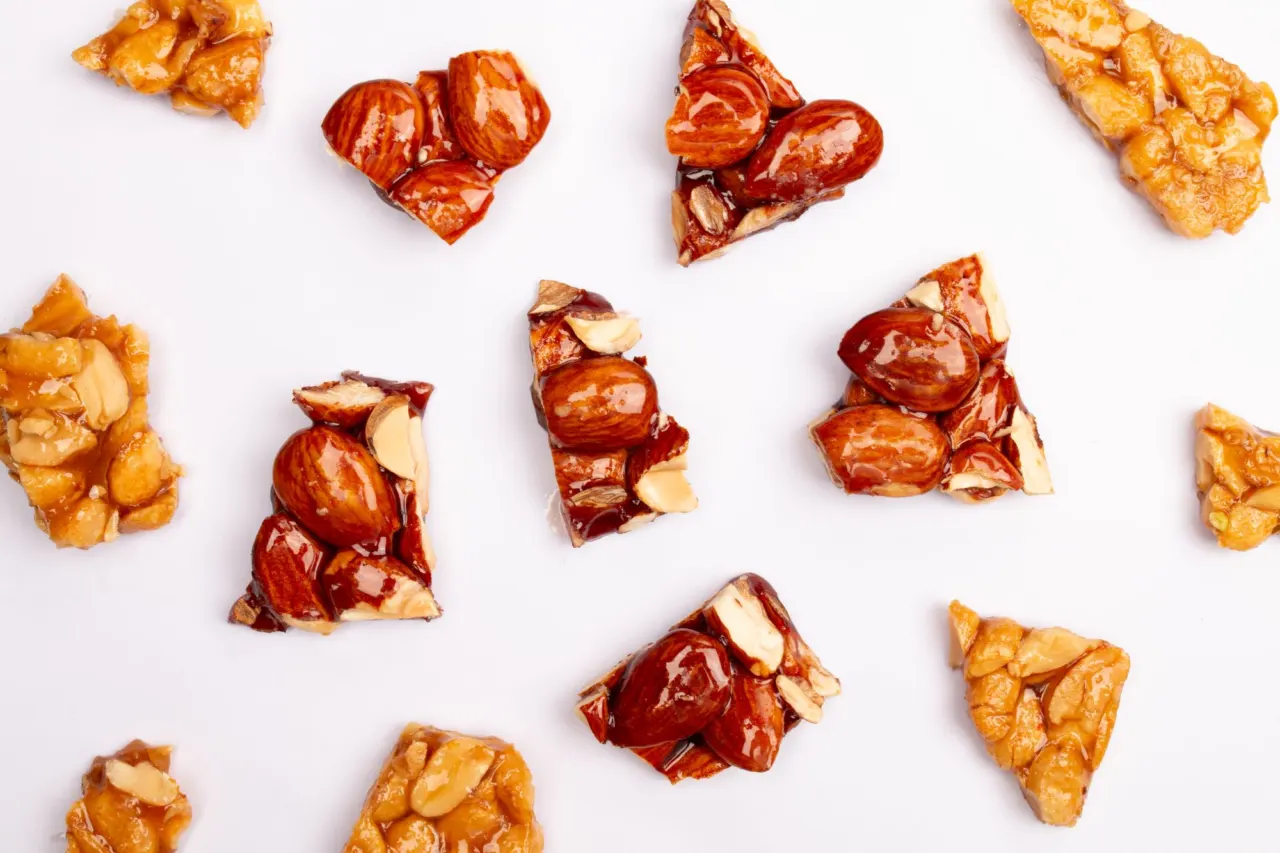
Provençal black nougat is made with just two ingredients, honey and whole almonds, cooked together without any egg whites. You stir constantly until the honey caramelises and the almonds toast, at around 145 to 150 °C, then immediately pour the brown mixture between two sheets of edible wafer paper and cut it while still warm. The recipe is simple, but it needs your full attention: a few minutes too long and the honey turns bitter.
Method
- Prepare the tin Set the 20 x 20 cm frame or tin on a baking tray and line the base with a sheet of wafer paper. Keep the second sheet close at hand, along with the board and weight you will use to press the nougat: once the cooking is done, everything moves very quickly.
- Warm the almonds Preheat the oven to 120 °C and warm the almonds in it for about ten minutes. They will toast in the honey; the aim is simply to stop cold almonds from bringing down the temperature in the pan.
- Cook the honey Pour the honey into a fairly deep, heavy-based saucepan, as it foams a lot as it heats. Bring it to the boil over a medium heat and let it cook for 5 to 8 minutes, stirring from time to time, until it reaches about 120 °C.
- Add the almonds Tip in the hot almonds all at once, with the orange zest if using. Stir with the wooden spoon, scraping the bottom well, so that every almond is coated in honey.
- Caramelise, stirring Turn the heat down slightly and keep cooking for 12 to 15 minutes, stirring constantly. The honey darkens to an amber brown, and the almonds crackle and toast right through. Stop between 145 and 150 °C: a drop of the mixture dropped into a glass of cold water should harden at once and snap cleanly.
- Pour and press Immediately pour the mixture into the tin, spread it with the back of the lightly oiled spoon, cover with the second sheet of wafer paper, then press with the board and weight to make an even slab.
- Cut while still warm After 15 to 20 minutes, when the slab is firm but still warm, turn it out and cut it into bars, then pieces, with a large oiled knife, pressing down firmly. Once completely cold, black nougat shatters rather than slices.
- Leave to cool Leave the pieces to cool for about 2 hours at room temperature, somewhere dry, before putting them away.
Which honey should you choose?
Lavender honey (€15 for a 300 g jar) gives a rounded black nougat, with a mellow caramel flavour and a subtle floral note: it is the most classic choice. Garrigue honey (€13), a multifloral honey from the hills of the wild Mediterranean scrubland, brings more fragrance. For a darker, bolder nougat, chestnut honey (€15) offers a woody bitterness that pairs well with toasted almonds; it caramelises faster, so watch its colour closely, or mix it half and half with lavender honey. The recipe calls for 400 g of honey, or two 300 g jars: the rest can go into white nougat.
Tips and variations
- For a softer black nougat that gives easily under the teeth, stop cooking at around 135 to 140 °C. Above 150 °C, the nougat becomes very brittle and the honey may taste bitter.
- Unblanched almonds, with their skins on, are traditional: they give a more toasted flavour and a lovely colour. You can replace some of the almonds with hazelnuts.
- Crystallised honey works perfectly well: it turns liquid again within the first few minutes of cooking.
- Caramelised honey goes above 140 °C and sticks to the skin: keep children away from the pan and never taste the hot mixture.
- Black nougat is quite different from white honey nougat, which is softer and made with whisked egg whites and a sugar syrup. In Provence, the two sit side by side among the thirteen Christmas desserts.
Storage
Black nougat keeps for several weeks, up to about a month, in an airtight container at room temperature, away from humidity. Separate the pieces with sheets of baking paper so they do not stick together, and avoid the fridge, which makes it tacky. Packed in a pretty box, it makes a much-appreciated gift; you will find more ideas in our selection of Christmas food gifts.
Frequently asked questions
What is the difference between black nougat and white nougat?
Black nougat contains only honey and almonds, cooked together until caramelised: it is brown, crunchy and tastes of caramel. White nougat is made with whisked egg whites, cooked honey and a sugar syrup, which gives it its creamy colour and soft texture.
Why is my black nougat soft or sticky?
The cooking was probably stopped too early, leaving too much water in the honey. Aim for 145 to 150 °C, or check that a drop of the mixture hardens and snaps cleanly in cold water. Humid weather or a container that does not close properly can also soften the nougat afterwards.
Can you make black nougat without a thermometer?
Yes, by relying on the colour and the cold-water test. The honey should turn amber brown and the almonds should crackle; a drop of the mixture dropped into cold water should harden at once and break without bending. A thermometer is still safer the first time.
How do you clean the pan after making black nougat?
Do not scrape off the hardened caramel. Fill the pan with very hot water and leave it to soak, or bring the water to a simmer for a few minutes: the caramelised honey dissolves on its own.
Cook next