Honey recipeDesserts & teatime
Homemade Honey Nougat
Traditional white nougat made with lavender honey, whisked egg whites and toasted almonds and pistachios, set between two sheets of edible wafer paper. A slab of around thirty pieces, ideal for the thirteen desserts of a Provençal Christmas.
- Preparation45 min
- Cooking20 min
- Resting12 to 24 h
- Makes1 slab of 20 x 20 cm, about 30 pieces
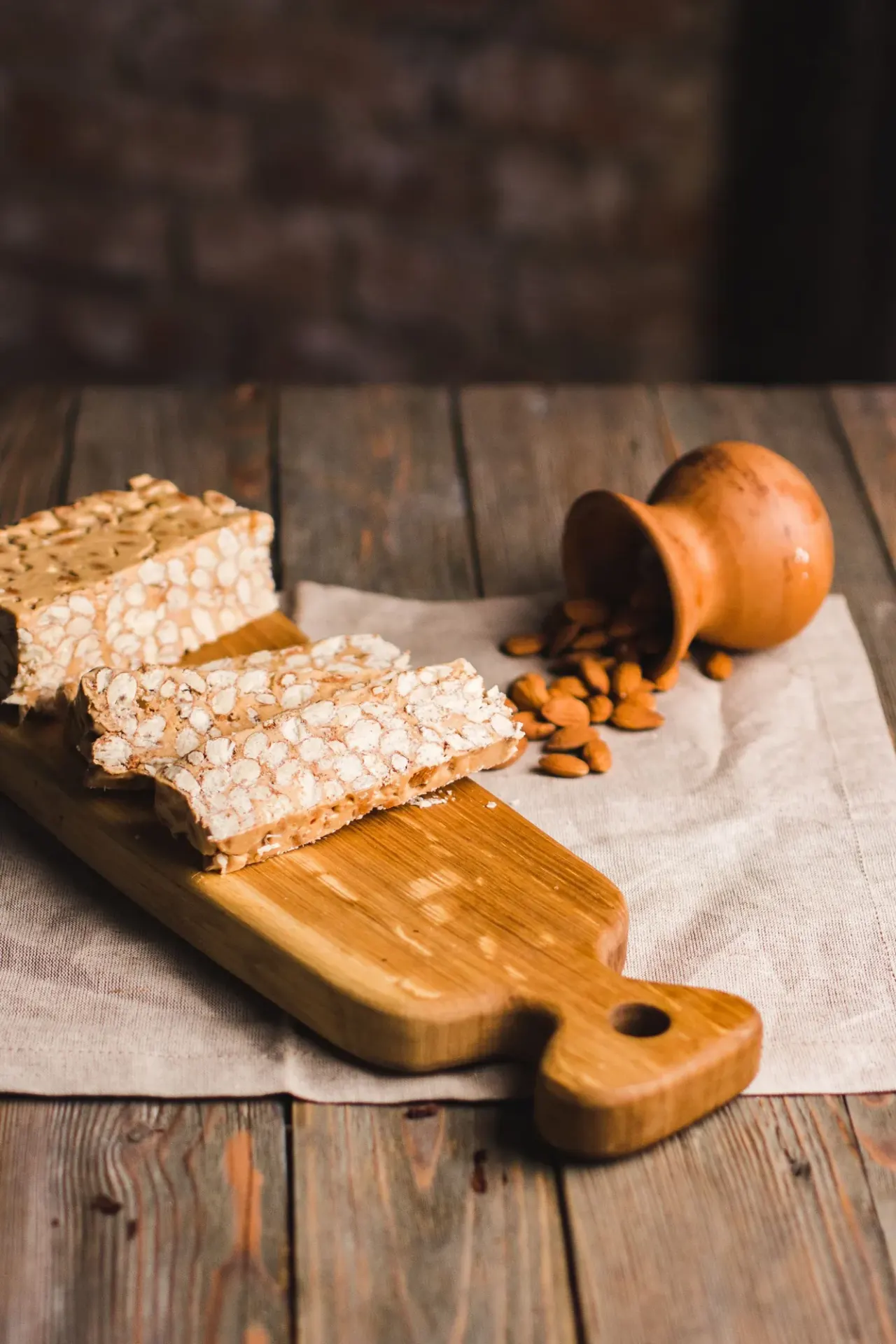
Homemade honey nougat is made by pouring honey cooked to about 125 °C, then a sugar syrup cooked to 145 °C, onto whisked egg whites, before folding in toasted almonds and pistachios while still hot. The mixture is spread between two sheets of edible wafer paper and left to set for 12 to 24 hours before slicing. A sugar thermometer is essential: a difference of just a few degrees is enough to make the nougat too soft or too hard.
Method
- Toast the nuts Preheat the oven to 150 °C. Spread the almonds and pistachios on a baking tray and toast them for 10 to 12 minutes, until fragrant. Lower the oven to 100 °C and keep them warm: cold nuts would make the mixture set too soon. Line the base of the tin with a sheet of wafer paper.
- Prepare the egg whites Put the egg whites in the bowl of the stand mixer with the pinch of salt, without whisking them yet.
- Start heating both pans Pour the honey into a first, fairly deep saucepan: it foams a lot as it cooks. In the second, put the sugar, water and glucose syrup. Heat both over a medium heat, with the thermometer in the honey.
- Make the honey meringue When the honey reaches 110 °C, start whisking the egg whites at medium speed. When it reaches 125 °C, take it off the heat and pour it in a thin stream onto the whites, with the mixer running, down the side of the bowl to avoid the whisk.
- Add the sugar syrup Meanwhile, keep cooking the sugar syrup until it reaches 145 °C, moving the thermometer into this pan. Pour it in turn in a thin stream onto the honey meringue, still whisking.
- Whisk until thick Keep whisking at medium speed for 8 to 10 minutes. The mixture thickens, turns white and becomes glossy; it is ready when it clings firmly to the whisk and forms a thick ribbon that barely falls back.
- Fold in the nuts Stop the mixer, add the warm almonds and pistachios and quickly fold them in with the lightly oiled spatula, before the mixture cools.
- Pour and press the nougat Immediately pour the nougat into the tin, cover with the second sheet of wafer paper and press down firmly with a board or the base of a dish to level the surface.
- Leave to set, then cut Leave to set for 12 to 24 hours at room temperature, somewhere dry, without putting the nougat in the fridge. Turn it out, then cut it into bars and pieces with a large knife, lightly oiled or dipped in hot water and wiped dry.
Which honey should you choose?
Lavender honey harvested in Provence is the reference honey for white nougat: its floral note and pale colour give a fragrant, creamy-white nougat. Thyme honey makes a more aromatic version, slightly deeper in colour. Very dark honeys, such as chestnut, are better suited to black nougat, in which the honey is caramelised. To give your nougat with a jar of the same honey, the Lavender and Garrigue Duo pairs the lavender honey used in white nougat with a more aromatic multifloral honey.
Tips and variations
- Prepare and weigh all the ingredients in advance: once the honey and syrup are cooking, the steps follow one another without a break.
- If the nougat is still too soft after setting, the syrup did not reach its temperature; for a firmer nougat, take the syrup to 150 °C next time. If it is too hard, go down to 140 °C.
- Glucose syrup limits the crystallisation of the sugar and gives a softer texture; without it, the nougat still works but is a little more crumbly.
- Add diced candied orange peel, or replace some of the almonds with toasted hazelnuts.
- White nougat is associated with Montélimar, in the Drôme, where making it is a long-standing tradition. In Provence, white nougat and black nougat are among the thirteen Christmas desserts, alongside honey gingerbread, dried fruit and nuts, and pompe à l’huile, an olive oil brioche.
Storage
Homemade nougat keeps for three to four weeks in an airtight container, away from heat and humidity, ideally with the pieces wrapped individually in baking paper or greaseproof paper. The fridge makes it sticky: keep it at room temperature. Nicely wrapped, it makes a lovely food gift; find more ideas in our guide to Christmas food gifts.
Frequently asked questions
Do you need a thermometer to make nougat?
Yes, it is essential. How firm the nougat is depends directly on the temperature of the honey, about 125 °C, and of the sugar syrup, about 145 °C. By eye, it is impossible to judge the few degrees that separate a soft nougat from a brittle one.
Why is my nougat too soft?
The sugar syrup probably did not reach 145 °C, or the mixture was not whisked for long enough. Humid weather can also soften nougat. Next time, take the syrup a few degrees higher and whisk for longer.
Can you eat wafer paper?
Yes. Wafer paper is a thin edible sheet with no pronounced taste, made from starch and water. It stops the nougat from sticking and is eaten with it.
How long does homemade nougat keep?
Three to four weeks in an airtight container, at room temperature and somewhere dry. Made at the beginning of December, it will be ready for the thirteen Christmas desserts.
Cook next